Biography
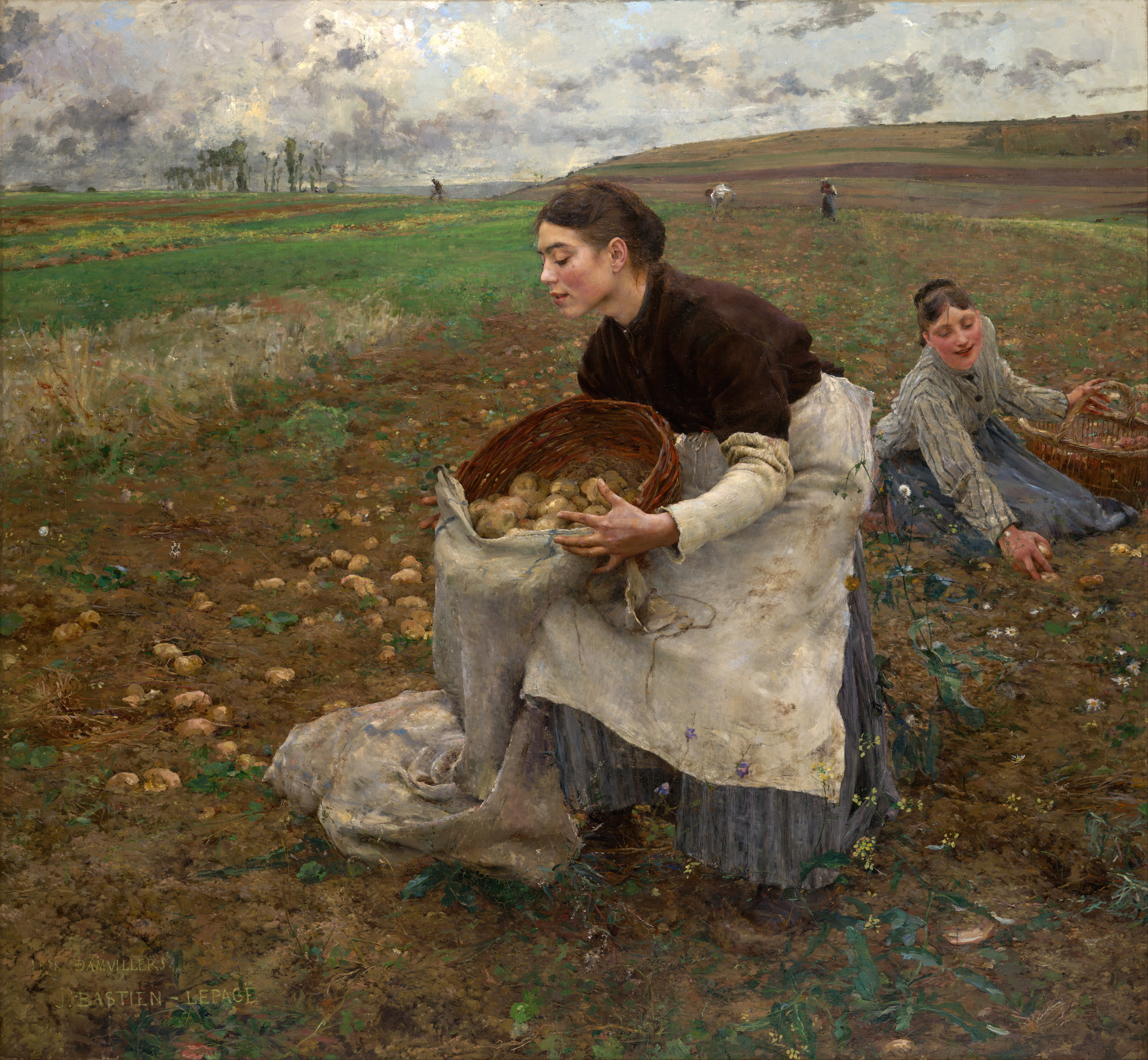
Jules Bastien-Lepage (1 November 1848 – 10 December 1884) was a French painter closely associated with the beginning of naturalism, an artistic style that emerged from the later phase of the Realist movement.
His most famous work is his landscape-style portrait of Joan of Arc which is held at the Metropolitan Museum in New York City.
Jules Bastien-Lepage’s first teacher was his father, himself an artist. His first formal training was at Verdun. Prompted by a love of art, he went to Paris in 1867, where he was admitted to the École des Beaux-arts, working under Cabanel. He was awarded first place for drawing, but spent most of his time working alone, only occasionally appearing in class. Nevertheless, he completed three years at the school. In a letter to his parents, he complained that the life model was a man in the pose of a mediaeval lutanist.
During the Franco-Prussian war in 1870, Bastien fought and was wounded. After the war, he returned home to paint the villagers and recover.
His initial success was confirmed in 1875 by the First Communion, a picture of a little girl minutely worked up in manner that was compared to Hans Holbein, and a Portrait of M. Hayern. In 1875, he took second place in the competition for the Prix de Rome with his Angels Appearing to the Shepherds, exhibited again at the Exposition Universelle in 1878. His next attempt to win the Prix de Rome in 1876 with Priam at the Feet of Achilles was again unsuccessful (it is in the Lille gallery), and the painter determined to return to country life. To the Salon of 1877 he sent several works, including Haymaking (Les Foins). The last picture, now in the Musée d’Orsay, was widely praised by critics and the public alike. It secured his status as one of the first painters in the Naturalist school.
After the success of Haymaking, Bastien-Lepage was recognized in France as the leader of the emerging Naturalist school. By 1883, a critic could proclaim that “The whole world paints so much today like M. Bastien-Lepage that M. Bastien-Lepage seems to paint like the whole world.” This fame brought him prominent commissions.
His Portrait of Mlle Sarah Bernhardt (1879), painted in a light key, won him the cross of the Legion of Honour. In 1879 he was commissioned to do make a portrait of the Prince of Wales. In 1880 he exhibited a small portrait of M. Andrieux and an historical painting of Joan of Arc (now in the Metropolitan Museum of Art); and in the same year, at the Royal Academy, the small portrait of the Prince of Wales. In 1881 he painted The Beggar and the Portrait of Albert Wolf; in 1882 Le Père Jacques; in 1885 Village Love, in which we find some trace of Gustave Courbet’s influence. His last dated work is The Forge (1884).
Nationality:
French
Dates:
November 1, 1848 – December 10, 1884
Occupation:
Painter
Schools attended:
Student of:
Teacher of: