Biography
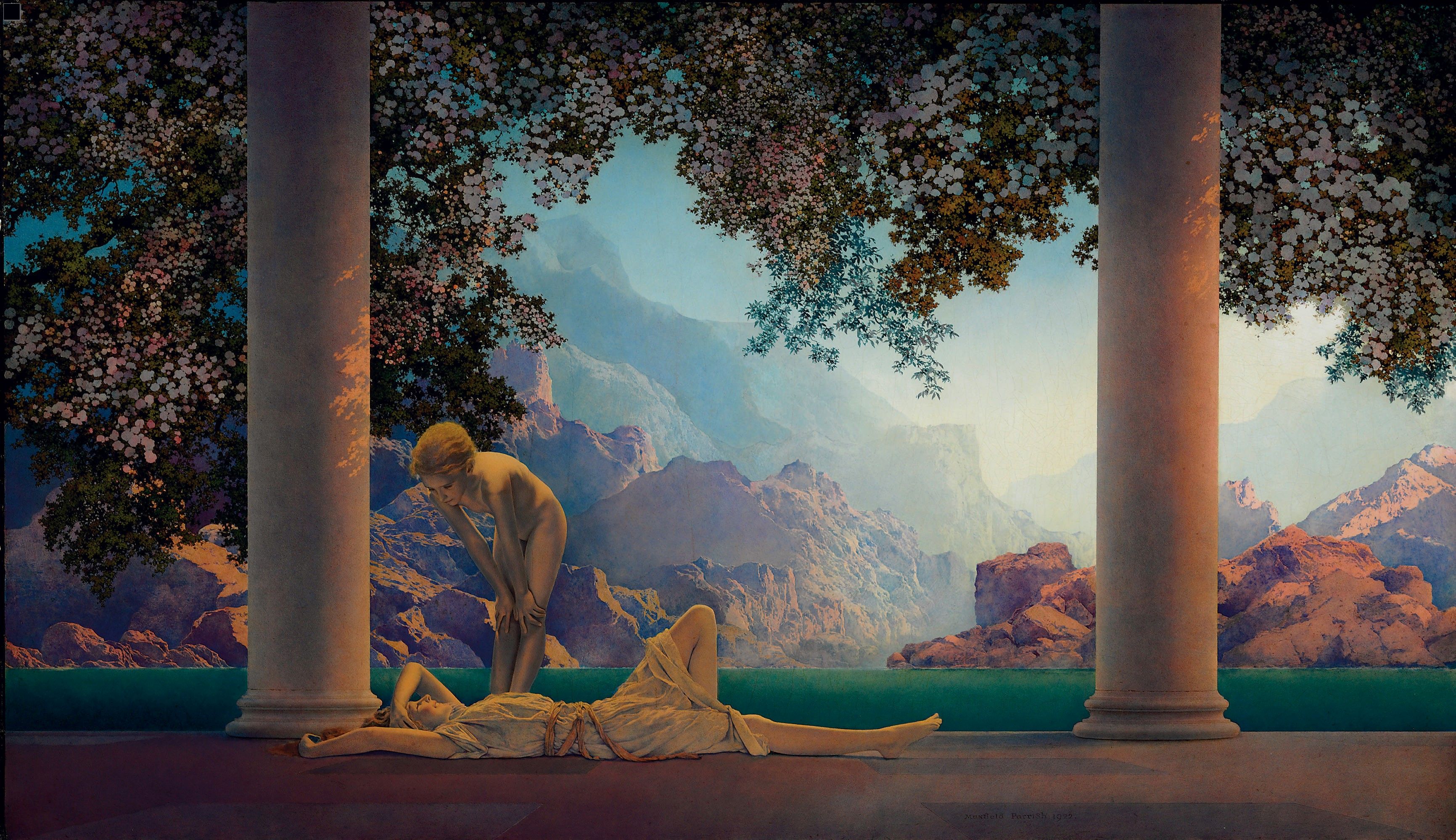
Maxfield Parrish (July 25, 1870 – March 30, 1966) was an American painter and illustrator active in the first half of the 20th century. He is known for his distinctive saturated hues and fantasy imagery. His career spanned fifty years and was highly successful: the National Museum of American Illustration deemed his painting Daybreak (1922) to be the most successful art print of the 20th century.
Maxfield Parrish was born in Philadelphia, Pennsylvania, to painter and etcher Stephen Parrish and Elizabeth Bancroft. His given name was Frederick Parrish, but he later adopted Maxfield, his paternal grandmother’s maiden name, as his middle, then finally as his professional name. He was raised in a Quaker society. As a child he began drawing for his own amusement, showed talent, and his parents encouraged him. Between 1884 and 1886, his parents took Parrish to Europe, where he toured England, Italy, and France, was exposed to architecture and the paintings by the old masters, and studied at the Paris school of Dr. Kornemann.

He attended the Haverford School and later studied architecture at Haverford College for two years beginning in 1888. To further his education in art, from 1892 to 1895 he studied at the Pennsylvania Academy of the Fine Arts under artists Robert Vonnoh and Thomas Pollock Anschutz. After graduating from the program, Parrish went to Annisquam, Massachusetts, where he and his father shared a painting studio. A year later, with his father’s encouragement, he attended the Drexel Institute of Art, Science & Industry where he studied with Howard Pyle.
The Lantern Bearers (1908), created for Collier’s magazine, shows Parrish’s use of glazes and saturated color in an evocative night scene. Crystal Bridges Museum of American Art
Parrish entered into an artistic career that lasted for more than half a century, and which helped shape the Golden Age of illustration and American visual arts. During his career, he produced almost 900 pieces of art including calendars, greeting cards, and magazine covers. Parrish’s early works were mostly in black and white.
In 1895, his work was on the Easter edition of Harper’s Bazaar. He also did work for other magazines like Scribner’s Magazine. One of his posters for The Century Magazine was published in Les Maîtres de l’Affiche. He also illustrated a children’s book in 1897, Mother Goose in Prose written by L. Frank Baum. By 1900, Parrish was already a member of the Society of American Artists. In 1903, he traveled to Europe again to visit Italy.

Parrish took many commissions for commercial art until the 1920s. Parrish’s commercial art included many prestigious projects, among which were Eugene Field’s Poems of Childhood in 1904, and such traditional works as Arabian Nights in 1909. Books illustrated by Parrish are featured in A Wonder Book and Tanglewood Tales in 1910, The Golden Treasury of Songs and Lyrics in 1911, and The Knave of Hearts in 1925.
Parrish was earning over $100,000 per year by 1910, when homes could be bought for $2,000.
In 1910 Parrish received a commission to create 18 panels to go into the Girls Dining Room of the Curtis Publishing Company building, then under construction at 6th and Walnut in Philadelphia. It would take him six years to finish the monumental project. In 1914, before the murals were completed, Curtis commissioned Parrish to design a 15-by-49-foot (4.6 m × 14.9 m) mural for the building lobby. Tiffany Studios constructed a favrile glass mosaic mural titled The Dream Garden, which is now a part of Pennsylvania Academy of the Fine Arts collection.

Parrish worked with popular magazines throughout the 1910s and 1920s, including Hearst’s and Life. He also created advertising for companies like Wanamaker’s, Edison-Mazda Lamps, Colgate and Oneida Cutlery. Parrish worked with Collier’s from 1904 to 1913. He received a contract to deal with them exclusively for six years. He also painted advertisements for D.M. Ferry Seed Company in 1916 and 1923, which helped him gain recognition in the eye of the public. His most well-known art work is Daybreak which was produced in 1923. It features female figures in a landscape scene. The painting also has undertones of Parrish blue. In the 1920s, however, Parrish turned away from illustration and concentrated on painting.
In his forties, Parrish began working on large murals instead of just focusing on children’s books. His works of art often featured androgynous nudes in fantastical settings. He made his living from posters and calendars featuring his works. Beginning in 1904, Susan Lewin (1889-1978) posed for many works, and became Parrish’s longtime assistant. From 1918 to 1934, Parrish worked on calendar illustrations for General Electric.
In 1931, Parrish declared to the Associated Press, “I’m done with girls on rocks”, and opted instead to focus on landscapes. By 1935, Parrish exclusively painted landscapes. Though never as popular as his earlier works, he profited from them. He would often build scale models of the imaginary landscapes he wished to paint, using various lighting setups before deciding on a preferred view, which he would photograph as a basis for the painting (see for example, The Millpond). He lived in Plainfield, New Hampshire, near the Cornish Art Colony, and painted until he was 91 years old. He was also an avid machinist, and often referred to himself as “a mechanic who loved to paint”.

Parrish’s art is characterized by vibrant colors; the color Parrish blue was named after him. He achieved such luminous color through glazing. This process involves applying layers of translucent paint and oil medium (glazes) over a base rendering. Parrish usually used a blue and white monochromatic underpainting.
With the new advancements in printing and distribution of his artwork, Parrish showed a vivid fantasy world to a wide public audience. His trademark luminous color was owing to a sophisticated process that involved a cobalt blue base and white undercoating to which he added a series of thin alternating coatings of oil and varnish. When exposed to ultraviolet light, the resins he employed, known as Damar, fluoresce a shade of yellow-green, giving the painted sky its distinctive turquoise tint.
Parrish used many other innovative techniques in his paintings. He would take pictures of models in black and white geometric printed fabric to help him accurately render patterns draping over the figure. Parrish also used scale models for structures and photo compositing to arrange his compositions.
The outer proportions and internal divisions of Parrish’s compositions were carefully calculated in accordance with geometric principles such as root rectangles and the golden ratio. In this Parrish was influenced by Jay Hambidge’s theory of Dynamic Symmetry.
Maxfield Parrish was highly influential on later illustrators, including Norman Rockwell. His influence can also be scene in rock ‘n’ roll album art (ex. Led Zeppelin’s Houses of the Holy and a direct quotation from Parrish’s Daybreak for Moody Blues The Present). Parrish is also mentioned as an influence on the set designs for Rivendell in the film adaptation of The Lord of the Rings directed by Peter Jackson.
Nationality:
American
Dates:
July 25, 1870 – March 30, 1966
Occupation:
Painter
Schools attended:
Drexel Institute of Art, Science & Industry, Pennsylvania Academy of the Fine Arts, Haverford College
Taught at:
Student of:
Robert Vonnoh, Thomas Anschutz, Howard Pyle
Teacher of:
Group / Movement:
Society of American Artists, Cornish Art Colony