Biography
John Singer Sargent (January 12, 1856 – April 14, 1925) was an American expatriate artist, considered the leading portrait painter of his generation for his evocations of Edwardian-era luxury. He created roughly 900 oil paintings and more than 2,000 watercolors, as well as countless sketches and charcoal drawings. His oeuvre documents worldwide travel, from Venice to the Tyrol, Corfu, Spain, the Middle East, Montana, Maine, and Florida.
Born in Florence to American parents, he was trained in Paris before moving to London, living most of his life in Europe. At the age of thirteen, he received some watercolor lessons from Carl Welsch, a German landscape painter. He was well-acquainted with many of the great masters from first-hand observation, as he wrote in 1874, “I have learned in Venice to admire Tintoretto immensely and to consider him perhaps second only to Michelangelo and Titian.”

An attempt to study at the Academy of Florence failed, as the school was reorganizing at the time. After returning to Paris from Florence, Sargent began his art studies with the young French portraitist Carolus-Duran. Following a meteoric rise, the artist was noted for his bold technique and modern teaching methods; his influence would be pivotal to Sargent during the period from 1874 to 1878.
In 1874, Sargent passed on his first attempt the rigorous exam required to gain admission to the École des Beaux-Arts, the premier art school in France. He took drawing classes, which included anatomy and perspective, and gained a silver prize. He also spent much time in self-study, drawing in museums and painting in a studio he shared with James Carroll Beckwith. He became both a valuable friend and Sargent’s primary connection with the American artists abroad. Sargent also took some lessons from Léon Bonnat.

Carolus-Duran’s atelier was progressive, dispensing with the traditional academic approach, which required careful drawing and underpainting, in favor of the alla prima method of working directly on the canvas with a loaded brush, derived from Diego Velázquez. It was an approach that relied on the proper placement of tones of paint. Sargent would later create a painting in this style that prompted comments such as: “The student has surpassed the teacher.”
This approach also permitted spontaneous flourishes of color not bound to an underdrawing. It was markedly different from the traditional atelier of Jean-Léon Gérôme, where Americans Thomas Eakins and Julian Alden Weir had studied. Sargent was the star student in short order. Weir met Sargent in 1874 and noted that Sargent was “one of the most talented fellows I have ever come across; his drawings are like the old masters, and his color is equally fine.”


He enjoyed international acclaim as a portrait painter. An early submission to the Paris Salon in the 1880s, his Portrait of Madame X, was intended to consolidate his position as a society painter in Paris, but instead resulted in scandal. During the next year following the scandal, Sargent departed for England where he continued a successful career as a portrait artist.
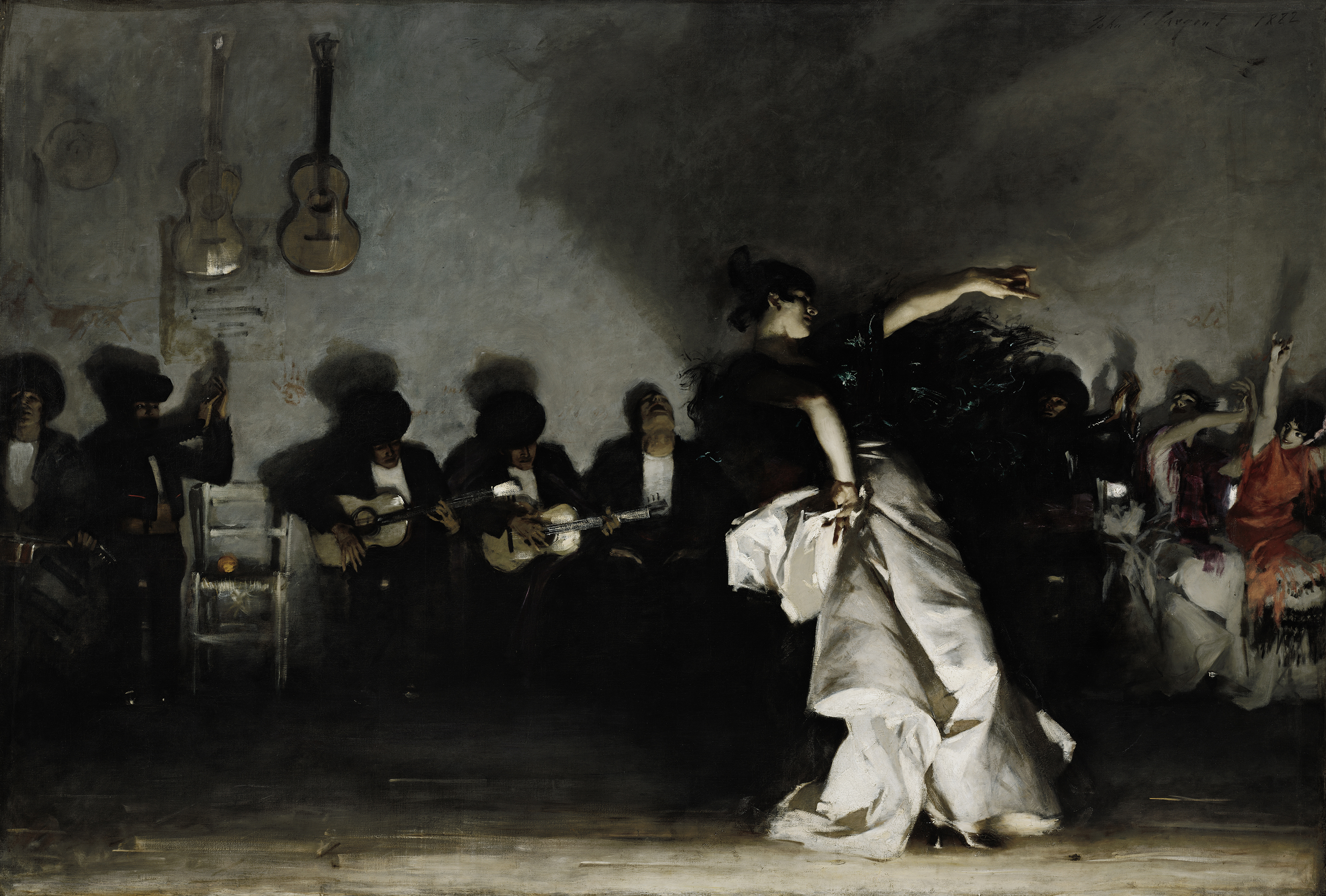
From the beginning, Sargent’s work is characterized by remarkable technical facility, particularly in his ability to draw with a brush, which in later years inspired admiration as well as criticism for a supposed superficiality. His commissioned works were consistent with the grand manner of portraiture, while his informal studies and landscape paintings displayed a familiarity with Impressionism. In later life Sargent expressed ambivalence about the restrictions of formal portrait work, and devoted much of his energy to mural painting and working en plein air. Conventional art history generally ignored society artists such as Sargent until the late 20th century.
Nationality:
American
Dates:
January 12, 1856 – April 14, 1925
Occupation:
Painter
Schools attended:
École des Beaux-Arts
Taught at:
Student of:
Léon Bonnat, Carolus-Duran
Teacher of: