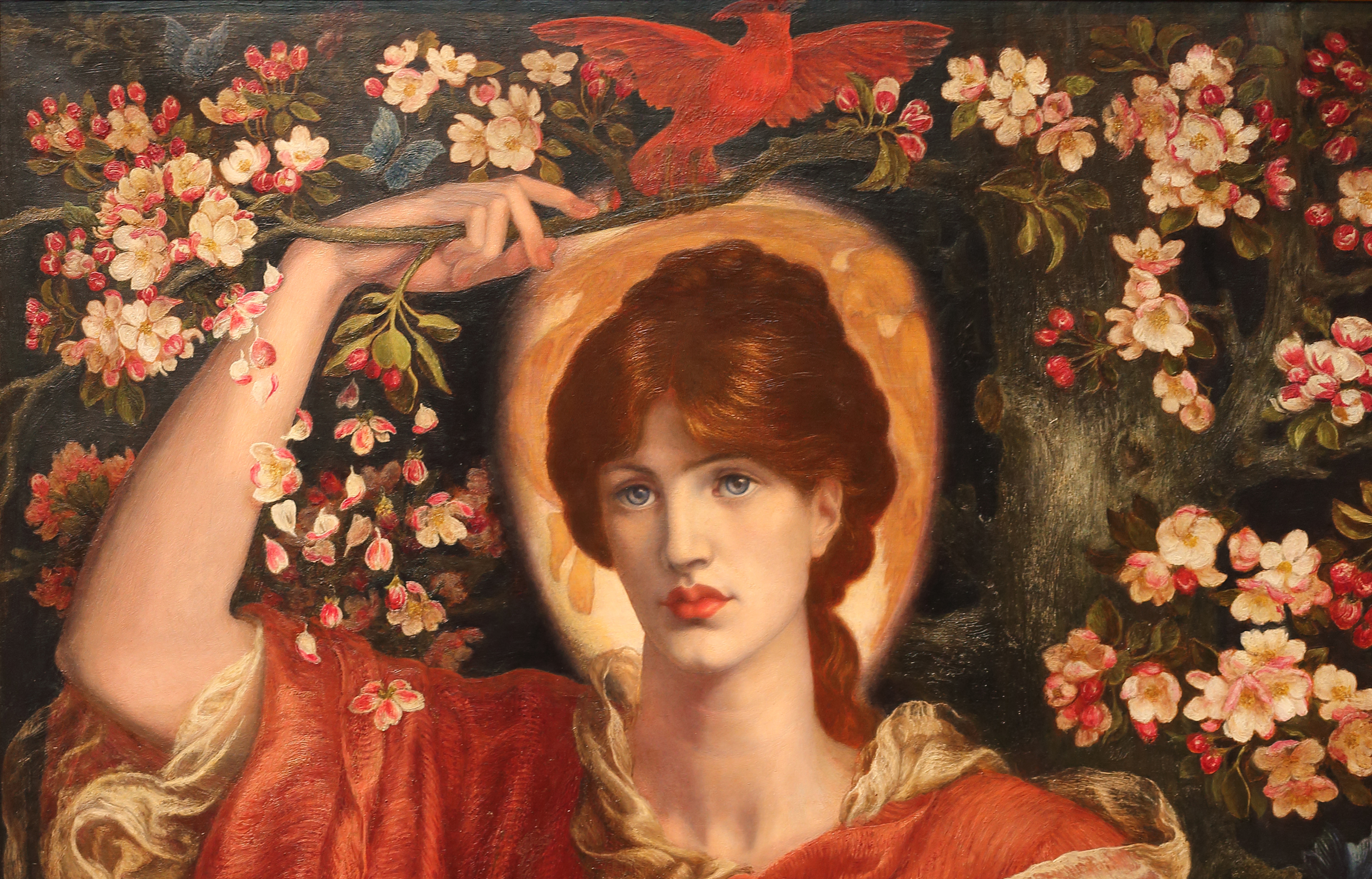
The Pre-Raphaelite Brotherhood (PRB, later known as the Pre-Raphaelites) was a group of English painters, poets, and art critics, founded in 1848 by William Holman Hunt, John Everett Millais, Dante Gabriel Rossetti, William Michael Rossetti, James Collinson, Frederic George Stephens and Thomas Woolner who formed a seven-member “Brotherhood” partly modelled on the Nazarene movement. The Brotherhood was only ever a loose association and their principles were shared by other artists of the time, including Ford Madox Brown, Arthur Hughes and Marie Spartali Stillman. Later followers of the principles of the Brotherhood included Edward Burne-Jones, William Morris and John William Waterhouse.
The group sought a return to the abundant detail, intense colours and complex compositions of Quattrocento Italian art. They rejected what they regarded as the mechanistic approach first adopted by Mannerist artists who succeeded Raphael and Michelangelo. The Brotherhood believed the Classical poses and elegant compositions of Raphael in particular had been a corrupting influence on the academic teaching of art, hence the name “Pre-Raphaelite”. In particular, the group objected to the influence of Sir Joshua Reynolds, founder of the English Royal Academy of Arts, whom they called “Sir Sloshua”. To the Pre-Raphaelites, according to William Michael Rossetti, “sloshy” meant “anything lax or scamped in the process of painting … and hence … any thing or person of a commonplace or conventional kind”. The group associated their work with John Ruskin, an English critic whose influences were driven by his religious background. Christian themes were abundant.
The brotherhood’s early doctrines, as defined by William Michael Rossetti, were expressed in four declarations:
- to have genuine ideas to express;
- to study Nature attentively, so as to know how to express them;
- to sympathise with what is direct and serious and heartfelt in previous art, to the exclusion of what is conventional and self-parading and learned by rote; and
- most indispensable of all, to produce thoroughly good pictures and statues.
The group continued to accept the concepts of history painting and mimesis, imitation of nature, as central to the purpose of art. The Pre-Raphaelites defined themselves as a reform movement, created a distinct name for their form of art, and published a periodical, The Germ, to promote their ideas. The group’s debates were recorded in the Pre-Raphaelite Journal. The Brotherhood separated after almost five years.
Nationality:
English
Established:
1848
Subjects:
Painting, Sculpture, Poetry
Group / Movement:
Pre-Raphaelite Brotherhood
Original Members:
James Collinson, William Holman Hunt,
John Everett Millais, Dante Gabriel Rossetti, William Michael Rossetti, Frederic George Stephens, Thomas Woolner
Followers / Influenced:
Discover the Artists and Writers influenced by the Pre-Raphaelites
