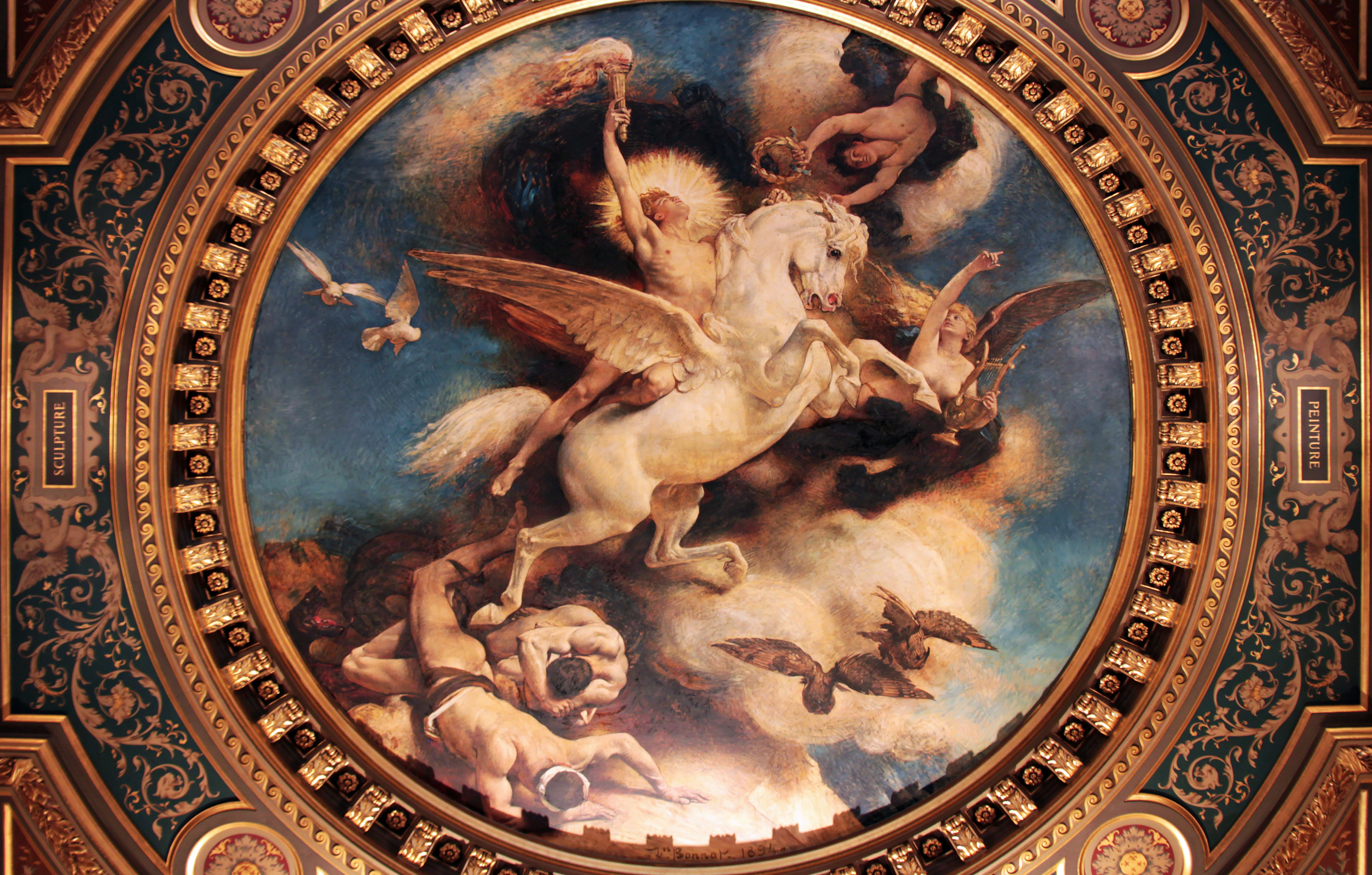
Biography
Léon Joseph Florentin Bonnat (20 June 1833 – 8 September 1922) was a French painter, Grand Officer of the Légion d’honneur, art collector and professor of many notable artists at the École des Beaux-arts in Paris.
Bonnat was born in Bayonne, but from 1846 to 1853 he lived in Madrid, where his father owned a bookshop. While tending his father’s shop, he copied engravings of works by the Old Masters, developing a passion for drawing. In Madrid he received his artistic training under Raimundo de Madrazo y Garreta. He later worked in Paris, where he became known as a leading portraitist, receiving many commissions. His many portraits show the influence of Velázquez, Jusepe de Ribera and other Spanish masters, as well as Titian and Van Dyke, whose works he studied in the Prado Museum. Following the period in Spain, Bonnat worked the studios of the history painters Paul Delaroche and Leon Cogniet in Paris. Despite repeated attempts, he failed to win the Prix de Rome, finally receiving second prize. However, a scholarship from his native Bayonne and support from the Personnaz family allowed him to spend three years in Rome (1858–60) independently where he and Antonin Personnaz became lifetime friends. During his stay in Rome, he also became friends with Edgar Degas, Gustave Moreau, Jean-Jacques Henner and the sculptor Henri Chapu.

Bonnat won a medal of honour in Paris in 1869. Bonnat went on to win the Grand Officer of the Légion d’honneur and became a professor at the École des Beaux-arts in 1882. Bonnat was popular with American students in Paris. In addition to his native French, he spoke Spanish and Italian and knew English well. In May 1905 he succeeded Paul Dubois as director of the École des Beaux-arts. Julius Kaplan characterised Bonnat as “a liberal teacher who stressed simplicity in art above high academic finish, as well as overall effect rather than detail.” Bonnat’s emphasis on overall effect on the one hand, and rigorous drawing on the other, put him in a middle position with respect to the Impressionists and academic painters like his friend Jean-Léon Gérôme. In 1904, Bonnat was elected into the Royal Academy of Science, Letters and Fine Arts of Belgium. In 1917, he was inducted into the National Academy of Design as an Honorary Corresponding member.
Bonnat showed great range in his subject matter, painting vivid portraits of contemporary celebrities as well as powerful religious paintings, such as his Christ on the Cross in the Musée du Petit Palais in Paris, Job in the Musée Bonnat, St Vincent Taking the Place of Two Galley Slaves at the church of Saint-Nicholas des Champs in Paris, and the large Martyrdom of St Denis for the Pantheon in Paris. He also did paintings of Italian peasants, and a small number of Oriental scenes.

The writers Émile Zola and Théophile Gautier were among Bonnat’s supporters. Gautier hailed him as “the antithesis of Bouguereau,” because of the stark naturalism and lack of surface finish that characterize Bonnat’s work. Bonnat was one of the only 14 painters who had administrative power over the Academie des Beaux-arts and thereby the École des Beaux-arts. He had friends and connections among the independent artists of his time as well, such as Edgar Degas, whom he met during his stay in Rome and who painted two portraits of Bonnat, and Édouard Manet, who shared his predilection for Spanish painting. He taught together with Pierre Puvis de Chavannes in the private atelier he ran before becoming professor at the École. He supported Auguste Rodin’s candidacy for the Institut, and defended Gustave Courbet’s submissions to the salon.
As a teacher he encouraged freedom of expression and execution, while his own work demonstrates a highly sophisticated and accurate anatomical drawing. He recommended traveling to Madrid to visit the Prado Museum, and introduced in Paris the tendency paint in the Spanish way.
In a gesture of gratitude for the help he had been provided in his youth and with the assistance of Antonin Personnaz, Bonnat built a museum in his native city of Bayonne, the Musée Bonnat. Most of the works in the museum are from the personal collections of Bonnat and Personnaz, amassed over a lifetime of travelling around Europe. It includes an exceptionally fine collection of Old Master drawings from Leonardo da Vinci and Michelangelo Buonarroti to Jean-Auguste Dominique Ingres and Théodore Géricault. Bonnat died on 8 September 1922 at Monchy-Saint-Éloi, and was buried at the Cimitiére Saint-Etienne, Bayonne.
Nationality:
French
Dates:
June 20, 1833 – September 8, 1922
Occupation:
Painter
Schools attended:
Taught at:
École des Beaux-arts
Student of:
Raimundo de Madrazo y Garreta, Paul Delaroche, Leon Cogniet
Teacher of:
John Singer Sargent, Stanhope Forbes, Gustave Caillebotte, Prince Eugen, Duke of Närke, Gustaf Cederström, Laurits Tuxen, P. S. Krøyer, Suzor-Coté, Robert Harris, Alfred Philippe Roll, Georges Braque, Thomas Eakins, Raoul Dufy, Jean Béraud, Franklin Brownell, Marius Vasselon, Hubert-Denis Etcheverry, Fred Barnard, Louis Béroud, Paul de la Boulaye, Aloysius O’Kelly, Erik Werenskiold, Graciano Mendilaharzu, Edvard Munch, Alphonse Osbert, Henry Siddons Mowbray, Francis Petrus Paulus, Charles Sprague Pearce, Henri de Toulouse-Lautrec, Hyakutake Kaneyuki, Nils Forsberg, Walter Tyndale, Émile-Louis Foubert, and Harry Watrou
Group / Movement:
Legion of Honour, National Academy of Design, Royal Academy of Science, Letters and Fine Arts of Belgium