Biography
Kenyon Cox (Oct. 27, 1856 – March 17, 1919) was an American painter and art critic, known for his murals and decorative work.
Cox was a pupil of Carolus-Duran and of Jean-Léon Gérôme in Paris from 1877 to 1882, when he returned to New York City, subsequently teaching with much success in the Art Students’ League. Among the better-known examples of his work are the frieze for the courtroom of the Appellate Court, New York City, and decorations for the Walker Art Gallery, Bowdoin College, Brunswick, Me., and for the capitol at St. Paul, Minn. He was the author of several books in which he generally argued against new movements in art and advocated what he termed “the classic point of view.”

Cox was an influential and important early instructor at the Art Students League of New York. He was the designer of the League’s logo, whose motto is Nulla Dies Sine Linea, “No Day Without a Line.”
Cox made a profound impact on the lives and careers of his students, who included Philadelphia-based painter Margaretta S. Hinchman and artist Jerome Myers, who studied with Cox during his early years of training at the Art Student’s League. Though Myers later took a very different path in his own artistic work, he clearly recalled this teacher in his 1940 autobiography, “Artist In Manhattan”:
Kenyon Cox belongs eminently to the traditions of my student days. At his art lectures I remember his eulogies of Michelangelo. Once he remarked that the master slept with his boots on–-which sounds so much more imposing than to sleep with one’s shoes on, as I have done. In our life classroom at the old Art Students League, there was a study by Kenyon Cox of a nude girl with red hair, a magnificent example, in oils, of vital life in the raw, an unforgettable canvas. It had a hole in it when I last saw it, and I do not know what became of it. In his mature work, however, Kenyon Cox sought for classic dignity; I remember a picture of his, called “The Flight of the Ideal,” that seemed to me a symbol of his aspirations. For myself, on the contrary, it was the earth that was attractive, the depicting of humans of my choice. Yet my study of the antique at art school made me sympathetic to this earnest devotee of classicism.

Cox advocated careful drawing, three-dimensional form, and structural anatomy, and he frequently used allegory and symbolism to present his ideas. Kenyon Cox painted in the realistic manner and earned a reputation for landscapes, portraits and genre studies. His idealized nudes and traditional treatment of classical themes stood in opposition to the more limited, optical and quotidian approach of Impressionism. Later, in 1912, Cox wrote an article for The Metropolitan Museum of Art Bulletin addressing this contrast titled “Two Ways of Painting”. In this article he describes the difference between the goals of the academic approach and the impressionist approach:
The pressure to conformity is upon the other side and it is the older methods that need justification and explanation. The prejudices of the workers and the writers have gradually and naturally become the prejudices of at least a part of the public, and it have become necessary to show that the small minority of artists who still follow the old roads do so, not from ignorance or stupidity or a stolid conservatism, still less from willful caprice, but from necessity; because those roads are the only ones that can lead them where they wish to go
Cox also began to write more articles and became an art critic for numerous magazines in New York including The Nation, Century and Scribner’s.

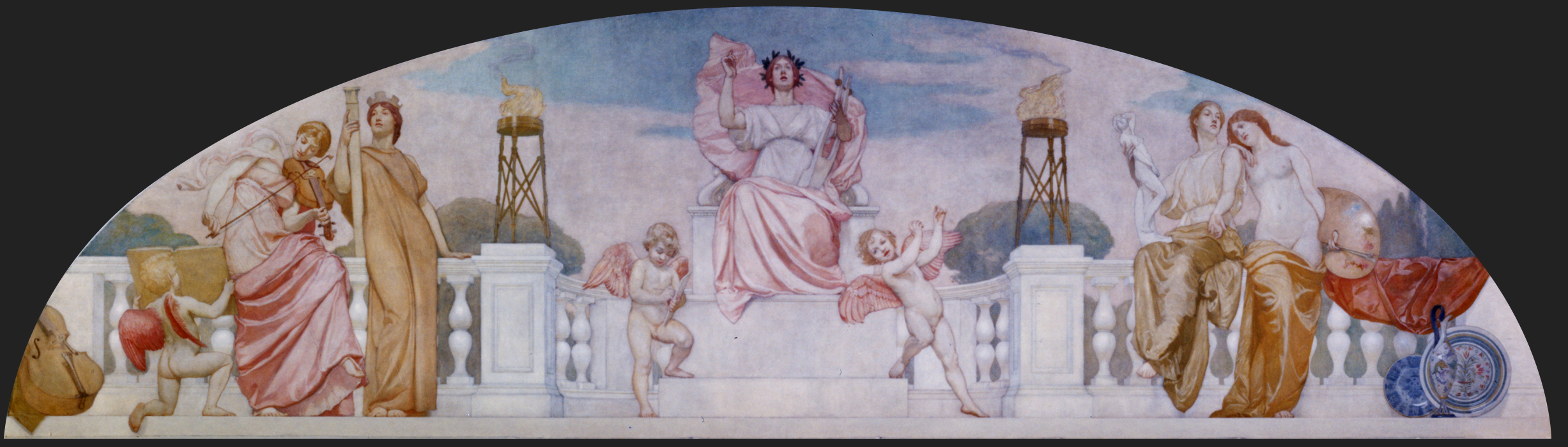
After the 1893 World’s Columbian Exposition in Chicago, he began to focus more on mural painting. Cox painted murals in the state capitol buildings of Des Moines, St. Paul and Madison as well as other courthouses, libraries and college buildings. In 1896-97 Cox painted murals in the Library of Congress in Washington, D.C. Cox also made numerous mosaics for places like the Wisconsin State Capitol building.
In 1910 Kenyon Cox was awarded the Medal of Honor for mural painting by the Architectural League. He also served as president of the National Society of Mural Painters from 1915 to 1919.

Cox continued to paint, teach and write until his death on March 17, 1919. Kenyon Cox died in his New York home from pneumonia. A significant body of Cox’s personal and professional papers, including extensive correspondence, is held in the Department of Drawings & Archives at the Avery Architectural and Fine Arts Library at Columbia University in New York City.
Nationality:
American
Dates:
Oct. 27, 1856 – March 17, 1919
Occupation:
Painter
Schools attended:
École des Beaux-arts, Pennsylvania Academy of Fine Arts
Taught at:
Art Students League
Student of:
Jean-Léon Gérôme, Alexandre Cabanel, Carolus-Duran
Teacher of:
Margaretta S. Hinchman, Jerome Myers