Biography
Jean-Léon Gérôme (11 May 1824 – 10 January 1904) was a French painter and sculptor. His paintings were so widely reproduced that he was “arguably the world’s most famous living artist by 1880.” The range of his oeuvre included historical painting, Greek mythology, Orientalism, portraits, and other subjects. He is considered one of the most important painters, educators, and proponents of skill-based art of the 19th century.
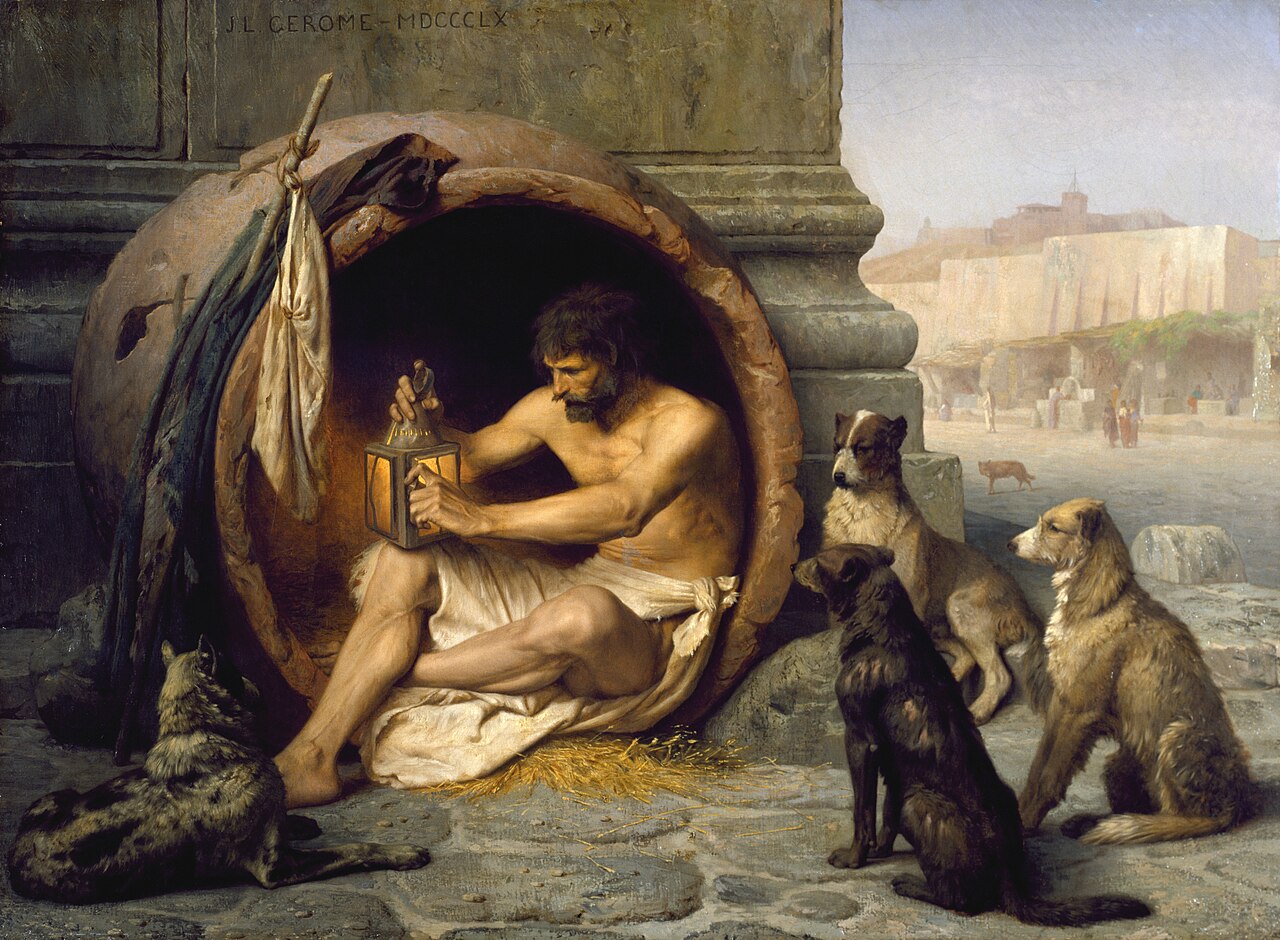
His historical and mythological compositions, such as Pygmalion and Galatea, were highly realized and imaginative. The surfaces of his paintings were expertly finished, and he exhibited a technical virtuosity with the figure, portrait, architecture, costume, flora and fauna. He had a command of lighting and ambient color that he could apply to both observed and invented settings. He was a capable draftsman in the tight linear style of Jean-Auguste-Dominique Ingres and an inventive illustrator in the manner of Delaroche. He also was highly versatile and experimental, creating paintings and sculptures of the same scenes and from multiple viewpoints as companion pieces, as well as using experimental combinations of materials and tinting in his sculpture work.
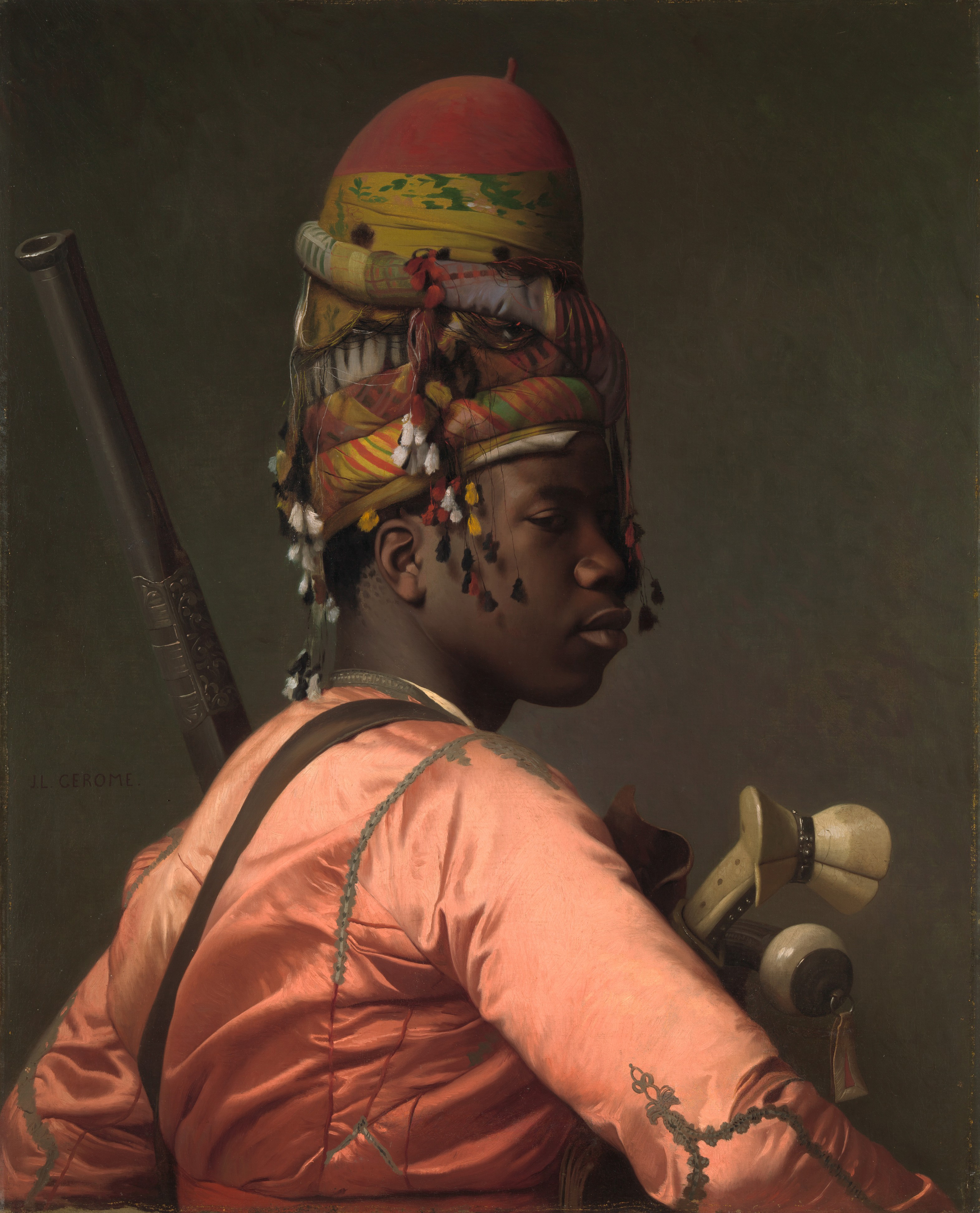
A trip to Egypt in 1856 introduced an exotic element into his painting and he painted many portraits and scenes for patrons of Oriental subjects.
Gérôme exhibited The Execution of Marshal Ney at the Salon of 1868. On behalf of Ney’s descendants, Gérôme was asked to withdraw the painting, but did not comply. The general reception was very split and the 1868 Salon marked the beginning of a lasting divide between Gérôme and many French art critics, who accused him of relying on literary techniques, of commercialising art, and of bringing politics into art. Henri Oulevay made a caricature where Gérôme is depicted in front of the wall with the art critics as the firing squad.
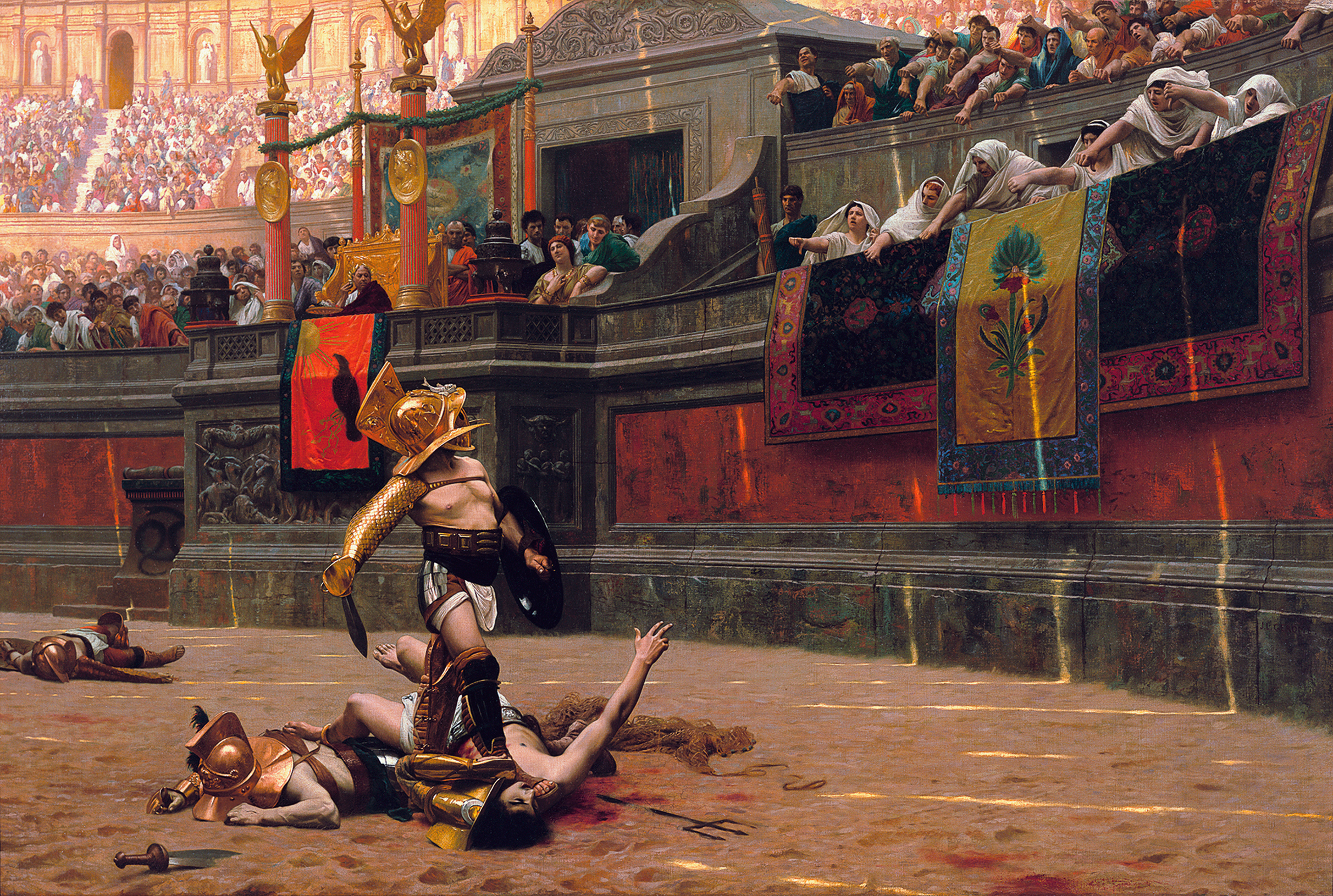
In 1872 Gérôme produced Pollice Verso, a painting of bloody gladiators and blood-thirsty Vestal virgins in the Colosseum that became one of his most famous works. Alexander Turney Stewart purchased the painting from Gérôme at a price of 80,000 francs, setting a new record for the artist. Gérôme’s imagery of the turned thumb to signal life or death for a fallen gladiator was repeated in a multitude of movies, from the silent era up to and including the 2000 Oscar-winner Gladiator.
Gérôme returned successfully to the Salon in 1873 with his painting L’Eminence Grise (Museum of Fine Arts, Boston), a colorful depiction of the main stair hall of the palace of Cardinal Richelieu, popularly known as the Red Cardinal (L’Eminence Rouge), who was France’s de facto ruler under King Louis XIII beginning in 1624. In the painting, François Le Clerc du Trembly, a Capuchin friar dubbed L’Eminence Grise (the Gray Cardinal), descends the ceremonial staircase immersed in reading the Bible while all others either bow before him or fix their gaze on him. As Richelieu’s chief adviser, L’Eminence Grise was called “the power behind the throne,” which became the known definition of his title.
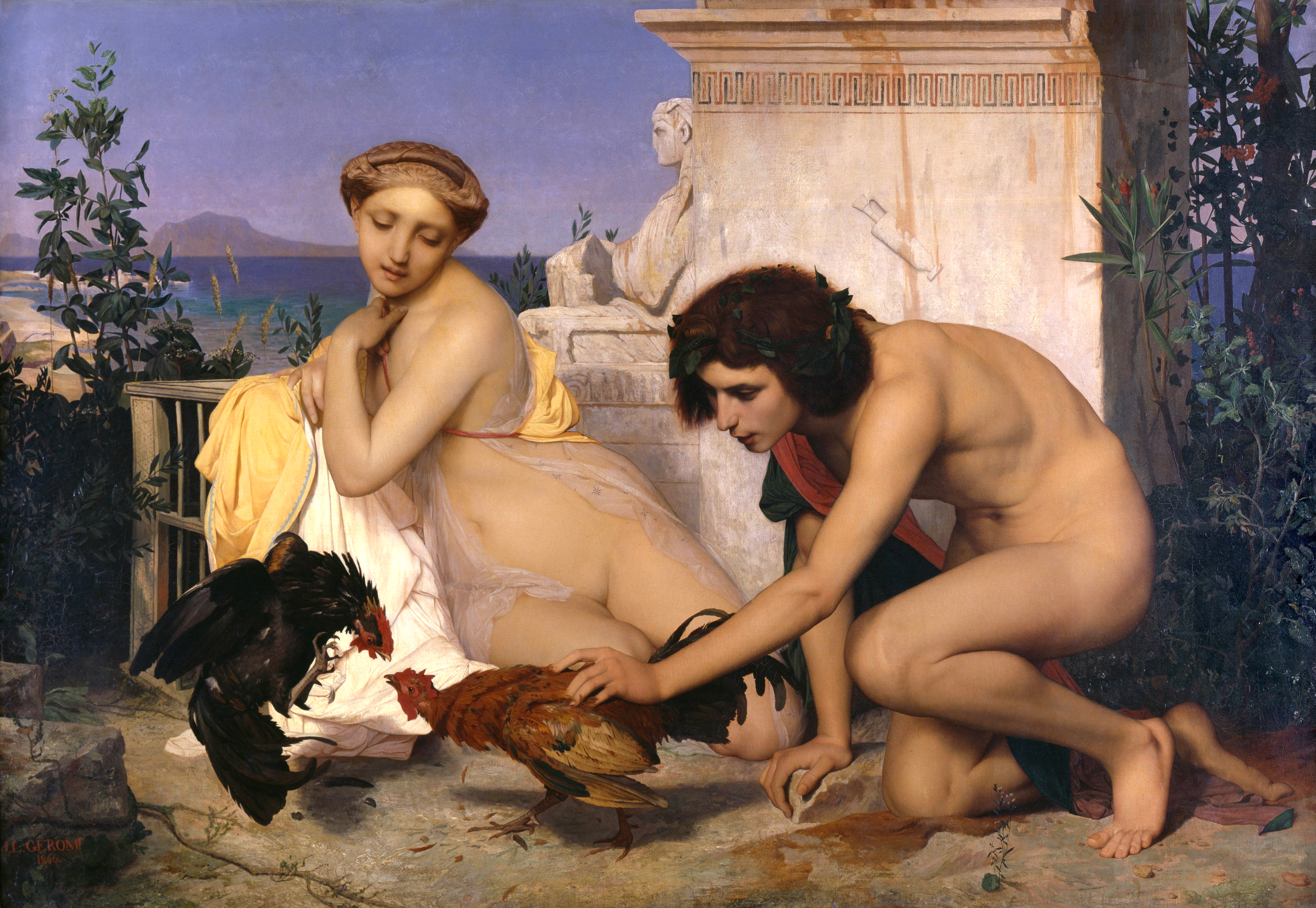
During the last 25 years of his life he concentrated on sculpture. His first work was a large bronze statue of a gladiator holding his foot on his victim, based on his painting Pollice Verso (1872) and shown to the public at the Universal Exhibition of 1878. The same year he exhibited a marble statue at the Salon of 1878, based on his early painting Anacreon, Bacchus and Eros (1848).

Aware of contemporary experiments of tinting marble (such as by those by John Gibson), he produced Dancer with Three Masks combining movement with color, first exhibited in 1902 and now in the Musée des Beaux-Arts de Caen. He also experimented with bronze and ivory inlaid with precious stones and paste. His Dancer was exhibited in 1891. His lifesize statue Bellona, in ivory, bronze, and gemstones, attracted great attention at the 1892 exhibition in the Royal Academy of London.
Gérôme was appointed as one of the three professors at the École des Beaux-Arts. He started with sixteen students. Between 1864 and 1904, more than 2,000 students received at least some of their art education through Gérôme’s atelier at the École des Beaux-Arts. Places in Gérôme’s atelier were limited, keenly sought and highly competitive. Only the best students were admitted and aspirants considered it an honour to be selected.
Gérôme progressed his students through drawing from antique works, casts and followed by life study with live models generally selected on the basis of their physique, but occasionally for their facial expression in a sequence of exercises known as the academie. Students drew parts of a bust before the entire bust, then parts of the live model before preparing full figures. Only when they had mastered sketching were they permitted to work in oils. They were also taught to draw clearly and correctly before consideration of tonal qualities. These principles informed an influential drawing course of plates with example drawings from life and classical and Renaissance era sculpture casts. He developed the materials with his student Charles Bargue, and they are still utilized in Classical Realism Atelier schools today.
In his school, the floor sloped so that students had the fullest view of the model from the rear of the room. Students sat around any model in order of seniority, with the more senior students towards the rear so that they could draw the full figure, while the more junior members sat towards the front and concentrated a section only.

A highly successful artist, Gérôme exerted great influence in the Paris art world. He was highly critical of the Impressionists, and, as late as 1893, urged the government to refuse a bequest of 65 of their works.
Gérôme died in 1904. At his own request, he was given a simple burial service without flowers. But the Requiem Mass given in his memory was attended by a former president of the Republic, most prominent politicians, and many painters and writers. He was buried in the Montmartre Cemetery in front of the statue La Douleur (Pain), which he had cast for his son Jean who had died in 1891.
Gérôme’s prodigious energy, long career, wide popularity and long teaching career resulted in an enormous body of work that now resides in museums and private collections around the world; Ackerman’s revised catalogue raisonné of 2018 lists approximately 700 paintings and 70 sculptures.
Nationality:
French
Dates:
May 11, 1824 – January 10, 1904
Occupation:
Painter
Schools attended:
École des Beaux-Arts
Taught at:
Student of:
Paul Delaroche, Charles Gleyre
Teacher of:
Odilon Redon, Mary Cassatt, Vasily Vasilyevich Vereshchagin, Stanisław Chlebowski, Ahmed Ali Bey, Henri-Camille Danger, Hosui Yamamoto, Thomas Eakins, Edwin Lord Weeks, Gottardo Piazzoni
Books:
Charles Bargue and Jean-Leon Gerome: Drawing Course