Biography
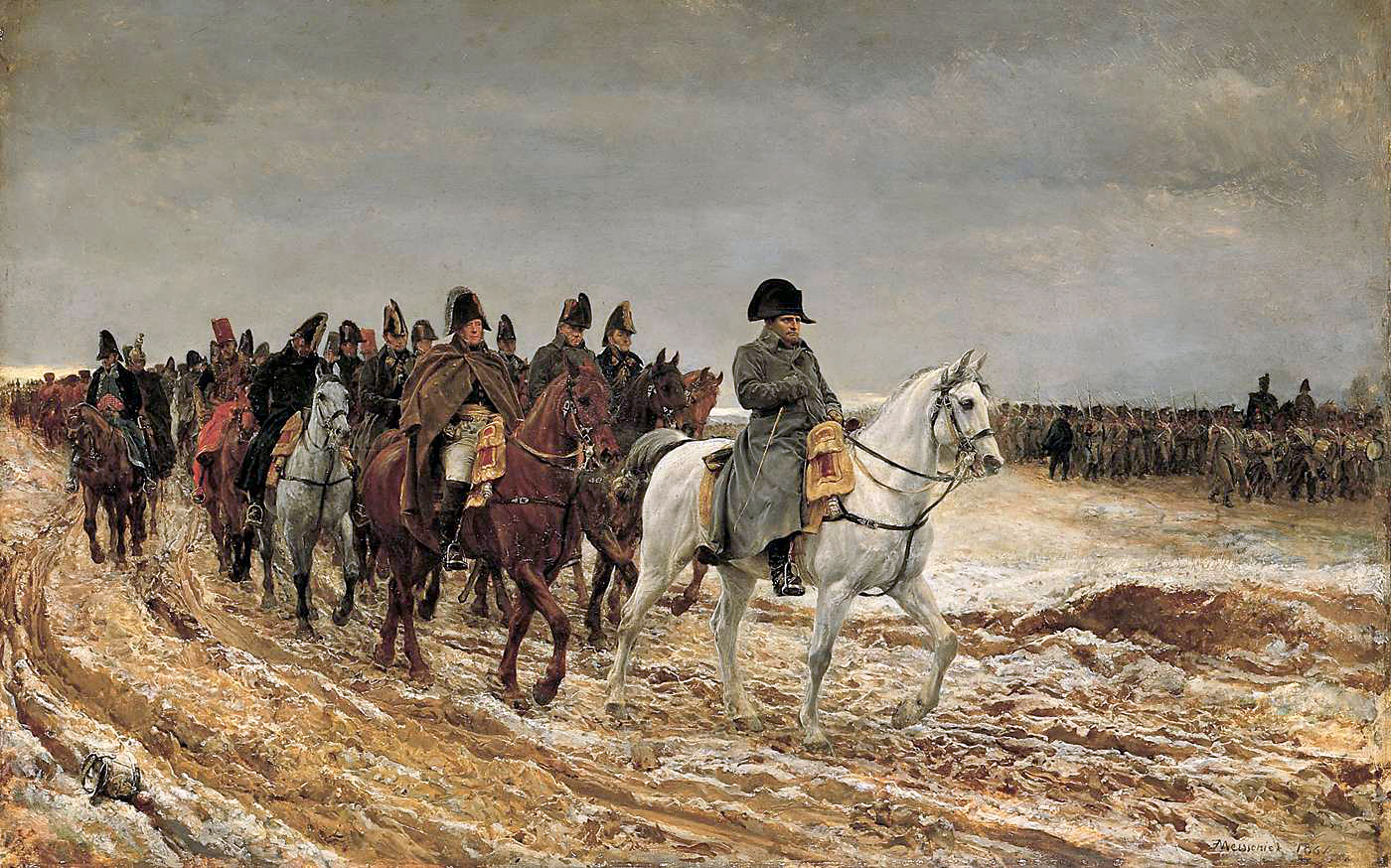
Jean-Louis-Ernest Meissonier (February 21, 1815 – January 31, 1891) was a French Classicist painter and sculptor famous for his depictions of Napoleon, his armies and military themes. He documented sieges and manoeuvres and was the teacher of Édouard Detaille.
From his schooldays Ernest showed a taste for painting, to which some early sketches, dated 1823, bear witness. Following the recommendation of a painter named Potier, himself a second class Prix de Rome, he was admitted to Léon Cogniet’s studio. He also formed his style after the Dutch masters as represented in the Louvre.


Meissonier enjoyed great success in his lifetime, and was acclaimed both for his mastery of fine detail and assiduous craftsmanship. The English art critic John Ruskin examined his work at length under a magnifying glass, “marvelling at Meissonier’s manual dexterity and eye for fascinating minutiae”.
Meissonier’s work commanded enormous prices and in 1846 he purchased a great mansion in Poissy, sometimes known as the Grande Maison. Meissonier himself said that his house and temperament belonged to another age. Like Alexandre Dumas, he excelled at depicting scenes of chivalry and masculine adventure against a backdrop of pre-Revolutionary and pre-industrial France, specializing in scenes from seventeenth- and eighteenth-century life.
Meissonier’s facility with composition, care with fine detail, historical accuracy, and management of mise en scene resulted in fully realized scenes where the viewer can feel as though he or she is peering through a window at the moment of action. The results are so lifelike that one can almost hear the ambient sounds within the scene. These achievements were a powerful expression of the goals of academic training in France the 19th century.

Nationality:
French
Dates:
February 21, 1815 – January 31, 1891
Occupation:
Painter
Schools attended:
Taught at:
Student of:
Léon Cogniet
Teacher of:
Édouard Detaille
Group / Movement:
Société Nationale des Beaux-Arts