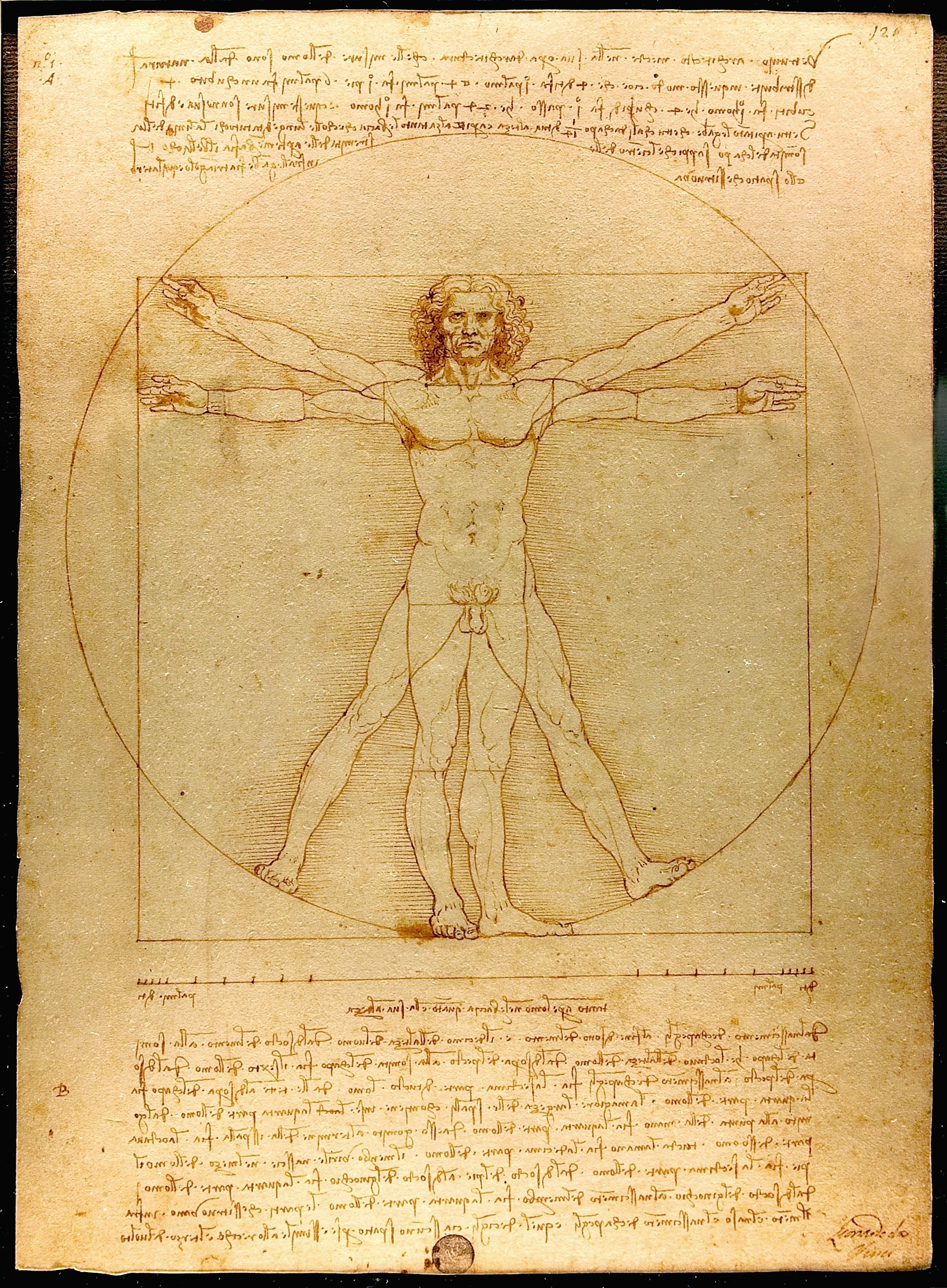

I received a genuine shock one day in a design meeting at a small advertising firm. A coworker pitched an idea involving a pastiche of Leonardo da Vinci’s most famous drawing: Vitruvian Man. In it, a male figure is circumscribed by a circle and square, demonstrating the regular proportions and perfect arcs that can be described by the movement of the human figure. It is a widely circulated, well known, powerful visual metaphor for the human understanding and utilization of physical forces. When he showed the visual and mentioned Leonardo da Vinci in the meeting, our own sales rep asked, “Who?”
I just can’t get past it. If he’d said, “Charles Sheeler” or “Dieter Rams” I would have understood her confusion. For an adult working in a creative profession to betray her ignorance like that… it’s a Festivus Miracle.
Medicine, biology, physics, optics, mechanics, drawing, painting, sculpture, European history – at no point in her education was a single innovation of this man in any of these disciplines ever made clear? It’s not like Americans know many “Leonardos” besides the polymath, the actor, and the Ninja Turtle.
In a previous article, I touched on the falsification of what makes an “artist.” The most common adult response to any mention of artistic skill is a profession of ignorance bordering on incapacity. This is because people have been deceived into thinking that such a thing as Artists exist and they have Secret Knowledge others cannot possess. So deceived, they consider artistic skill to be unattainable and therefore useless. In turn, they believe artists are only of interest to other artists.
Keeping people in the dark like this is reprehensible. Cultivating visual literacy is vital, especially since visual media are fast becoming the means by which important topics are introduced in education. Videos, even some produced by amateurs, are now forcing out in-person lecture, demonstration, and discussion by qualified teachers. Without any understanding of how visual media are produced and their power to communicate, how can the result be positive for students? Even if the video content is produced by reputable sources, the limitations of the medium should not be overlooked, but they often are. Highly-produced video content can have an immediacy, excitement, and air of authority that can greatly color perception of the opinions and editorial choices expressed. Do we not have a new generation of impressionable young people defenseless before a form of communication they are powerless to comprehend, to question and if necessary to doubt and reject? This is not a new problem, but its pervasiveness is new.
The American Psychological Association reports1 that children five and under cannot distinguish between television advertisements and programs. This is consistent with the American Academy of Pediatrics2 recommending limiting screen time to one hour per day, supervised, for children ages two to five. Under two, they recommend no screen time at all. Yet, it’s hard to walk through a public place where there are strollers and not notice very small children who are hooked into the Matrix. I haven’t noticed their parents otherwise occupied directing air traffic or negotiating the release of hostages. Yet, they apparently don’t have time to talk with their children and instead subject them to mind-numbing media consumption. This happens in Wal-Mart in the middle of nowhere Midwest, where I’m from. I used to unfairly attribute this to a population of humor-challenged souls who have very little culture. This is not true. It also happens in Central Park and Times Square. It happens every time there is a pause in the action of life. People of all ages are soaking in visual media.
Yes, and in the US we have been soaking in visual media for generations. Again, this is not new. But what is new is that the subway passenger no longer reads the physical copy of a bodice ripper or a tabloid. They no longer must risk such obvious social embarrassment. One may recall Planes, Trains and Automobiles and the racy pulp novel that Dell Griffith is reading when Neal Page recognizes him in the airport. It’s a clear signifier of poor taste. That signifier is still there, but you have to furtively glance at the screen next to you. Often, it’s the seven-second snippets of flotsam and jetsam for the baser motives, not the Kindle version of War and Peace. The availability of the pulp without the cover has done nothing if not degrade the average experience of media consumption in our in-between times. With the guilt and introspection gone, it is a short trip to hand the toddler a children’s dose of the opiate.
With discernment eroding, film is degrading, too. For so much to be made out of so little speaks volumes about visual literacy in our society. Rubbery CGI superheroes who lose their bones as soon as they leap in the air, vehicles which apparently weigh nothing one moment and many multiples of their curb weight the next, humans receiving many apparently fatal blows before succumbing, these do as much to sap the value of the material as the anemic, soulless writing. It’s hard to applaud when you’re rolling your eyes.
We now have generations of people who mindlessly consume media. This is highly correlative with generations who are ignorant and even hostile toward learning about media arts, to say nothing of fine art. What I had unfairly attributed to dull Midwestern life I now realize is a broadly American phenomenon, but it doesn’t have to be this way. Times have changed.
While in previous eras the stage, the radio, and the early days of television and film greatly limited and edited our exposure to art, this is no longer the case. The scope of what we can access via the internet is unprecedented. A wealth of information on art making, art history, art criticism, museum collections, auction results, and current traveling exhibitions are all more readily available to more people at a lower cost than ever before. So are the best films, TV series, music, graphic novels, etc.
With these tools, I am becoming less interested in blaming others for our ignorance. On the other hand, with these same tools, I am more inclined to blame the stewards of education for their neglect.
Every graduate of eighth grade in the US should be able to identify Leonardo da Vinci and a handful of his major works. He or she should be able to draw a few things: a proportional human head or human skull, the plan and elevation of the chair on which he or she sits every day, and the front elevation of his or her home. We should all know how to make a visual record of our surroundings.
If the basic ability to judge scale and proportion is beyond most people, how well can they visualize anything? If they have never tried to hone their powers of perception, organization, and recall, how much imagination can they have? How can they describe their bedroom or a loved one’s face?
With no cultivation of visual skills, their minds are not fully formed. Their minds resemble the hollowness of the environments in which they spend their time.
I believe that the preponderance of ugly places in the US directly results from generations of people who were discouraged from developing their visual sense. They are blind. We now have millions who are depressed by their surroundings in their homes, on their streets, in their offices, and even in their leisure time.3
We deserve better.
“Art appreciation” is not enough. Without developing the visual sense and using it in their daily lives, even the privileged college students who travel to Italy do not get much out of it. When walking in a land of pearls, they still behave like swine. Perhaps, in such a rich visual landscape, some may get a sense that they are missing something, and that can attract more than a passing interest. But I have witnessed such an incredible ratio of selfie-sticks to sketchbooks that I doubt it.
Everyone should draw. If you feel intimidated, start with something with no pressure to make something “artsy” or aesthetic. Since a picture is worth a thousand words, simply think of it as a more intricate way of recording the world around you.
Try this. Set aside a little time, say, about an hour. Get some paper, a pencil, a good eraser, and something solid to press on. Sit in a comfortable place facing an interesting part of the room. It could include a window or door. Now draw in light lines exactly what you see in front of you. Start with placing the largest lines and shapes, doing your best to arrange them accurately. Only once you have the big shapes in good relationships and orientations should you move on to details. You don’t have to include everything, just the biggest forms that describe the actual objects that make up the space. Not every striation in the wood grain, just the height and size of the table. Not the screws on the light switch cover plate, maybe just a rectangle exactly where the switch is on the wall. For bonus points, now imagine another object you would like to see there and try to “place” it in the drawing. You might keep it a fairly simple shape, like a vase, or a book. I guarantee you that if you really look and really draw, this process will open your eyes.
I’d love to hear about your experience. Did you feel like it progressed quickly or slowly? What were some of the challenges? What were some things you noticed you never had before? Do you like how your room looks? How did you change it by adding the object?
- https://www.apa.org/pubs/reports/advertising-children ↩︎
- https://www.mcri.edu.au/news/insights-and-opinions/how-much-too-much-screen-time?gclid=Cj0KCQiAsburBhCIARIsAExmsu6lGgZTg6B19ZtiEljLMzInoJbY0KnD2YtpxZ-v4N9Ztg6I7I1sS2oaAu2iEALw_wcB ↩︎
- https://www.news-medical.net/news/20230529/Study-shows-link-between-living-in-suburban-areas-and-depression-risk.aspx#:~:text=After%20such%20an%20analysis%2C%20the,than%20in%20inner%2Dcity%20areas. ↩︎




Leave a Reply