This is the first article for the visual art website Continuum. It promises to be candid, and you may judge whether it, like this site as a whole, is controversial.
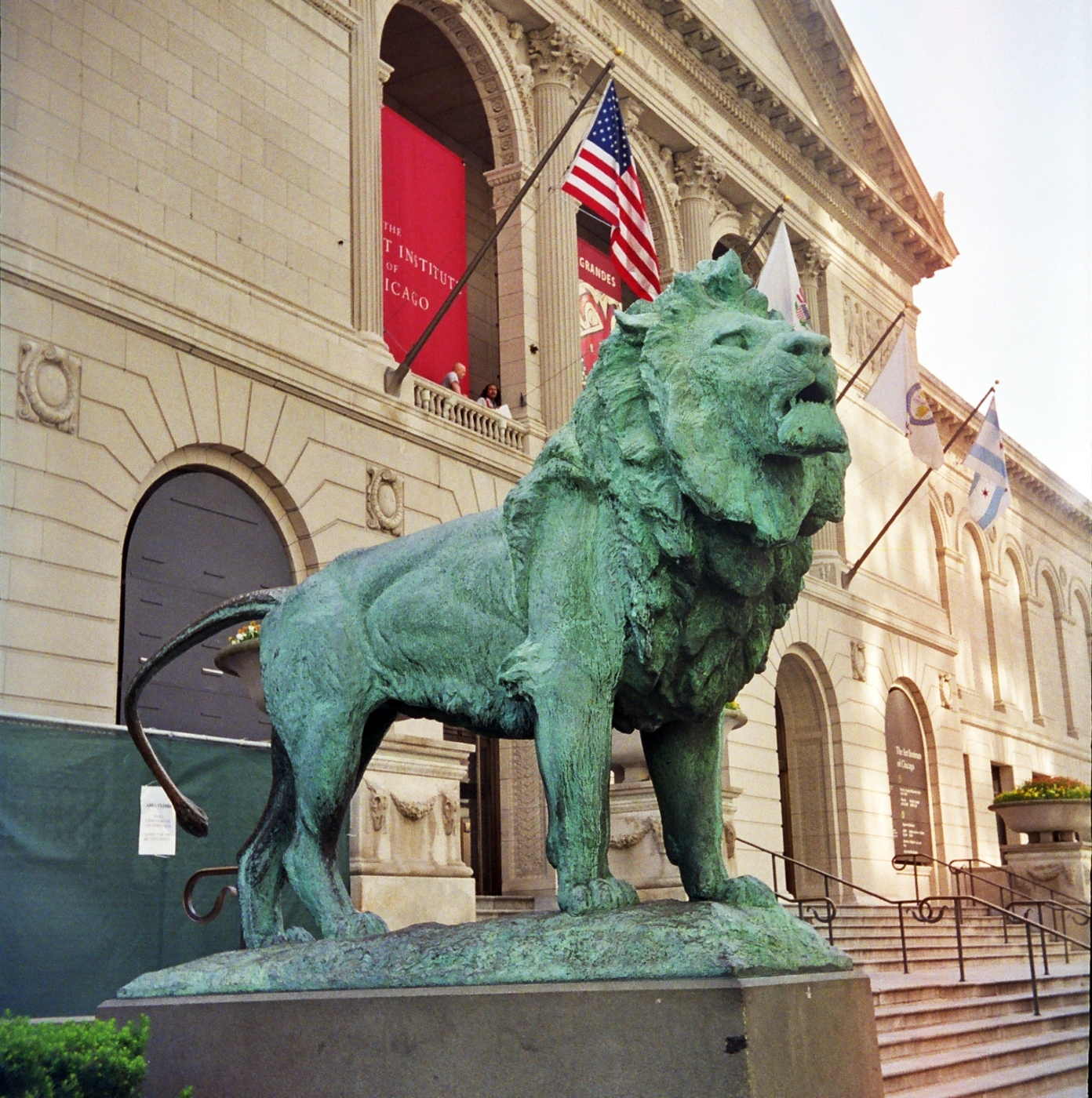
I could begin our conversation by claiming that it is a reaction to an article I just read about Why Everybody Hates Contemporary Art… but that would be incomplete. These ideas have been on my mind from childhood – ever since I saw “the arts” on WTTW (Chicago’s PBS station) represented by a shot of the iconic bronze lions in front of the Art Institute of Chicago. They have been filmed countless times as emblems of high culture in our third largest city, yet they are anonymous, as though they have just always been there. In fact, the lions were sculpted by the animalier Edward Kemeys and installed in 1894. That nearly no one today knows this is emblematic of what is absent from our discourse about visual art.
While disclosing my bias this early seems warranted, do not let it dissuade you from reading further or engaging in conversation with me. I am a full-time student at the Grand Central Atelier in New York. I chose this program after a personal revelation that nothing I could ever do in the arts would be fulfilling until I learned to draw, paint, and sculpt the same way that Phidias, Titian, Houdon, and Edward Kemeys learned.
This is the first of many hills on which you may expect me to be willing to die. And, insofar as I troubled myself to begin this conversation, it is the most important hill to defend. When it comes to training, no one can claim expertise without mastery – a carpenter, a surgeon, a musician, a painter or a sculptor. All must learn in the best tradition and devote themselves to the command of the rudiments and principles if they are to be competent, if not masterful.
By contrast, the fundamental tenet of Modern Art was to deny that skill exists. This is ridiculous, and that it is ridiculous is often felt, yet seldom expressed. The denial of skill is easy for most people to ridicule in carpentry and surgery. Malpractice in either case causes leaks, failure, and collapse. In music, it is a matter of degree – complete incompetence is easily heard, but the difference between major orchestras may not be.
Connoisseurship, then, consists mainly in the appreciation, opinion, and discourse on the finest gradations of skill. If skill is denied, then connoisseurship is impossible.
I am using the term Modern Art as it is characterized in the US, generally accepted as beginning in about 1860. I want to draw attention to that term, “modern” with a little “m,” In essence, it just means “current.”
In the same way, “contemporary” with a little “c,” also means “current,” so we are left to surmise that with a name equally meaningless, the fundamental tenet may be the same. It is not. It is worse. The fundamental tenet of Contemporary Art is that special people called Artists exist, and they are defined by their possession of Secret Knowledge.
This change was made possible by the promotion of Modern Art. Previously, there were disputes that included attempts at value judgments. But when one (or both) of the factions is in denial about skill, which can be evaluated, rational discussion, which is part of connoisseurship, cannot take place.
Into this void, the narrative of what art is and who artists are was also changed to deny skill. I submit that the reason why David Hockney impugns master artists’ abilities is not expert scholarship, but jealousy, since he himself cannot draw. This is contentious, I own that. What should not be contentious is that Caravaggio was a better draftsman than David Hockney. This is objectively true on the basis of human anatomy, the physics of light, and the science of optics (numerous scholars and experts have refuted the contention that Caravaggio used a camera obscura1 – more on that planned for a later article).
After a generation or two of denying skill, something had to be put in place in order to rationalize the money being thrown at unskillful, artless productions. Into this void was inserted the Artist with Secret Knowledge. While inherently meaningless, it seemed significant, and it has proved to be a very powerful lie. It has ensured that the avaricious would soon dominate the business of art.
Worse, the artists with useful knowledge, demonstrable skills and the power that results from them have also been falsely redefined as Artists having Secret Knowledge, indistinguishable from the Hockneys and the other hacks.
This view in all likelihood has and will continue to cost me money. I sleep more soundly knowing that.
Now, some may argue from a relativistic, politically correct, liberal, artsy-fartsy safe place of plausible deniability. “You are free to like what you like.” I agree there’s no accounting for taste. However, there is accounting for merit, and it is not the same thing as taste. It is one thing to sell a Brillo box or a self-shredding poster. From the standpoint of “taste,” a diamond-encrusted skull cannot be assailed if you are free to like it.
But denying skill to inflate the value of the Brillo box or the shredded poster is as fraudulent as Hirst’s allegedly lying about the sale of the skull. The claim was that it sold for $100 million. It did not sell at all.2 That kind of bookkeeping has landed quite a few people behind bars, especially when they stand to gain millions from the lie. Hirst did go on to bring in millions, all because without merit, unchecked avarice is permitted.
Here we may finally turn to that Medium article attributed to Ana F. Martín.3 The article makes several contentions:
- There is an “art world” with insiders and outsiders.
- New-media art is the future.
- Salvatore Garau sold something called the invisible sculpture for $18,000.
- Yoko Ono is an artist.
- Some people understand conceptual art and some do not.
- Art has nothing to do with beauty.
- Art has never been made for regular audiences.
- Not everybody can become an art spectator.
- In the 20th century abstract art became the norm over figurative, classical, fine art.
- Abstract art communicates things about art, while figurative representation does not.
None of those ten things are true. Not even number three, since Garau didn’t sell any thing. He simply accepted money for no thing in exchange. The only service I can imagine he performed was a magic trick. Maybe that makes him the world’s highest-earning magician? Well, we have other words for magicians.
I am a little rusty on my classical languages, but as close as I can figure, the words ars in Latin and tekne in Greek are where we get our terms and ideas for what we should rightly classify as “art.” Both societies produced incredible examples of highly influential art, and both of their terms referred to skilled craft. To debate this is to abandon the realm of art for the realm of philosophy, which is outside the scope of this website.
Therefore, to the degree that Modern Art denies skill, it is not art. To the degree that Contemporary Art claims secret knowledge as its replacement, it is not art. I am not damning everyone that has called themselves an artist since 1860. Far from it. But I judge their efforts in spite of the fallacies, not according to them.
If we deny this, we can’t have a meaningful discussion about art, which is all I want to do here. If we acknowledge it, that is the beginning of discourse, learning, and connoisseurship. Welcome.
- https://www.researchgate.net/publication/253341392_Did_early_Renaissance_painters_trace_optical_projections_Evidence_pro_and_con ↩︎
- https://news.artnet.com/art-world/damien-hirst-skull-storage-2064567#:~:text=He%20recently%20admitted%20that%20the,the%20deal%20never%20actually%20happened. ↩︎
- I suspect many of these “authors” are AI-generated to make programmatically designed high-traffic topical articles seem like genuine opinion pieces. Despite this, several points made are worthy of consideration. ↩︎


Leave a Reply