In her article “Beauty Treatment” for ArtForum, Rachel Wetzler quotes some forceful arguments in praise of beauty as a guiding principle:
Roger Scruton – “Beauty is vanishing from our world because we live as though it did not matter,” and relativism causes “a world in which human aspirations no longer find their artistic expression, in which we no longer make for ourselves images of the transcendent, and in which mounds of rubbish cover the sites of our ideals.”
Culture Critic (@Culture_Crit) on the Beaux-Arts masterpiece Penn Station – “Imagine how morally depraved a society must be to demolish this,” and “What inspires you more, a list of rules, or a beautiful ritual?”

Wetzler seems ambivalent, almost grudging, to concede these points, but she goes on to also cite several contemporary artists’ recent rediscovery of beauty. Her apparent reservations are nothing new and we pass over them without judgement. We welcome those artists who celebrate beauty and congratulate Wetzler on the mere mention of it, as well as “technique, color, and, above all else, visual pleasure” in an important publication like ArtForum.
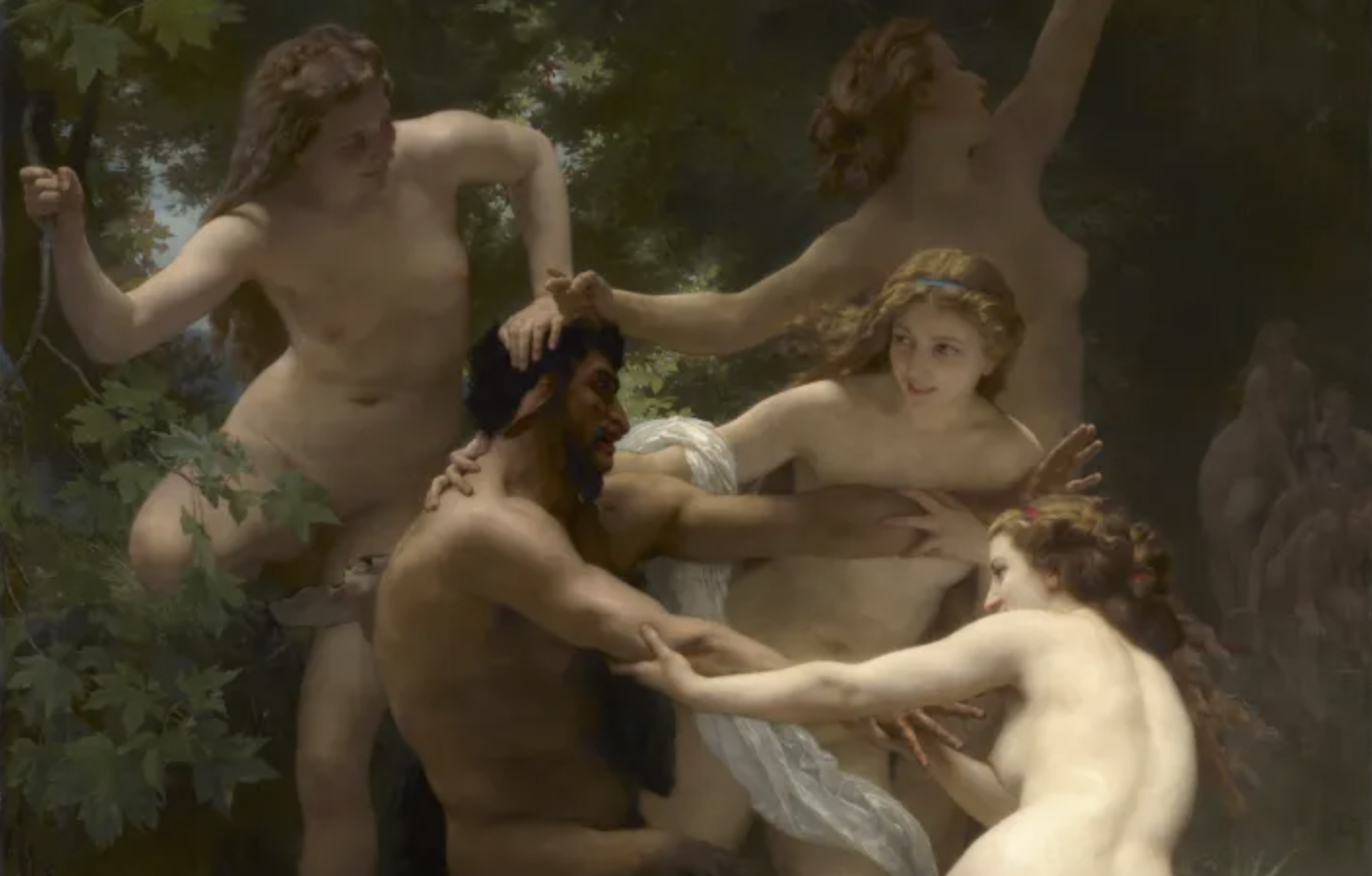
That aside, our interest is mainly in the artists she cites as examples. The Andy Dixon image included at the top of the article includes direct quotations from Gian Lorenzo Bernini’s Apollo and Daphne from 1625 and a figure from William-Adolphe Bouguereau’s Nymphs and Satyr from 1873, neither of which are cited by name and are instead apparently mislabeled “Rococo romances.” Wetzler says that these “same motifs are distilled” by Michaela Yearwood-Dan. I imagine this is a vote of approval, though I have yet to see those “same motifs” in any of those images myself.


Less convincing is the comparison where Cecily Brown “riffs on Jan Brueghel the Elder and Peter Paul Rubens’s suite of allegorical paintings, The Five Senses, 1617–18.” Upon closer scrutiny, I see that the works in question were created during the height of the pandemic, so perhaps Brown chose to show the senses as affected by Coronavirus. Either way, it is pleasant to bring Rubens to mind when talking about the use of a lot of flesh-colored paint. Also, to be fair, she mentions Andrew Cranston who is reminiscent of Édouard Vuillard and Pierre Bonnard’s haziness.

Wetzler groups other painters according to their recent interest in floral subjects, which she likens to the Dutch Golden Age. Besides flower paintings, Jordan Casteel and Jenna Gribbon turn domestic images of loved ones into colorful, earnest portrait essays. Sam McKinniss gives a similar treatment to photos of celebrities. All enliven their images with vibrant color and a genuine interest in their personality.

Meanwhile, some of the work looks like it is searching for something beyond the stylistic references relied on for familiarity. Despite the obvious overture to cubism and frankly rude subject matter, Louis Fratino seems to whisper to the viewer that he is a closet perspectivist. I suspect the same of Jonathan Gardner. It will be interesting to see what they do in the full light of day.
I want to believe that Wetzler is in earnest, as the article goes on to mention the rehabilitation of Dave Hickey on the grounds that beauty is now an acceptable subject in art school. Wetzler’s parting shot includes a quote from Hickey and labels beauty an “anarchy,” and urges us to not “cede this power to the right,” both of which I understand to be praise. Give it any name you need. I side with Shakespeare: a rose by any other name…
Wetzler writes:
I wonder if he wasn’t on to something. For Hickey, the invocation of beauty didn’t represent a conservative retrenchment, but an appealing anarchy: It directly addresses itself to the beholder, requiring neither interpretive intermediaries nor ameliorative social purpose. Instead of a set of orderly and unchallenging aesthetic conventions that mask the monstrousness of how things really are, beauty emerges here as a wild and uncontained relational force, one capable of seducing and convincing but also, perhaps, of subverting: “Any citizen conversant in the discourse of relative beauty, with its perpetual promise of radical destabilization,” says Hickey, “must then be predisposed to question established authority at every turn, because the experience of beauty itself invariably overrides it.”
Wetzler’s article is praiseworthy, and so are the artists who show this fascination with beauty. It is not trivial to include the figure by a 17th century master at The Armory or to attract comparisons with Dutch flower painters. Beauty, technique, color, and visual pleasure are the very things we can have a meaningful conversation about.

Leave a Reply