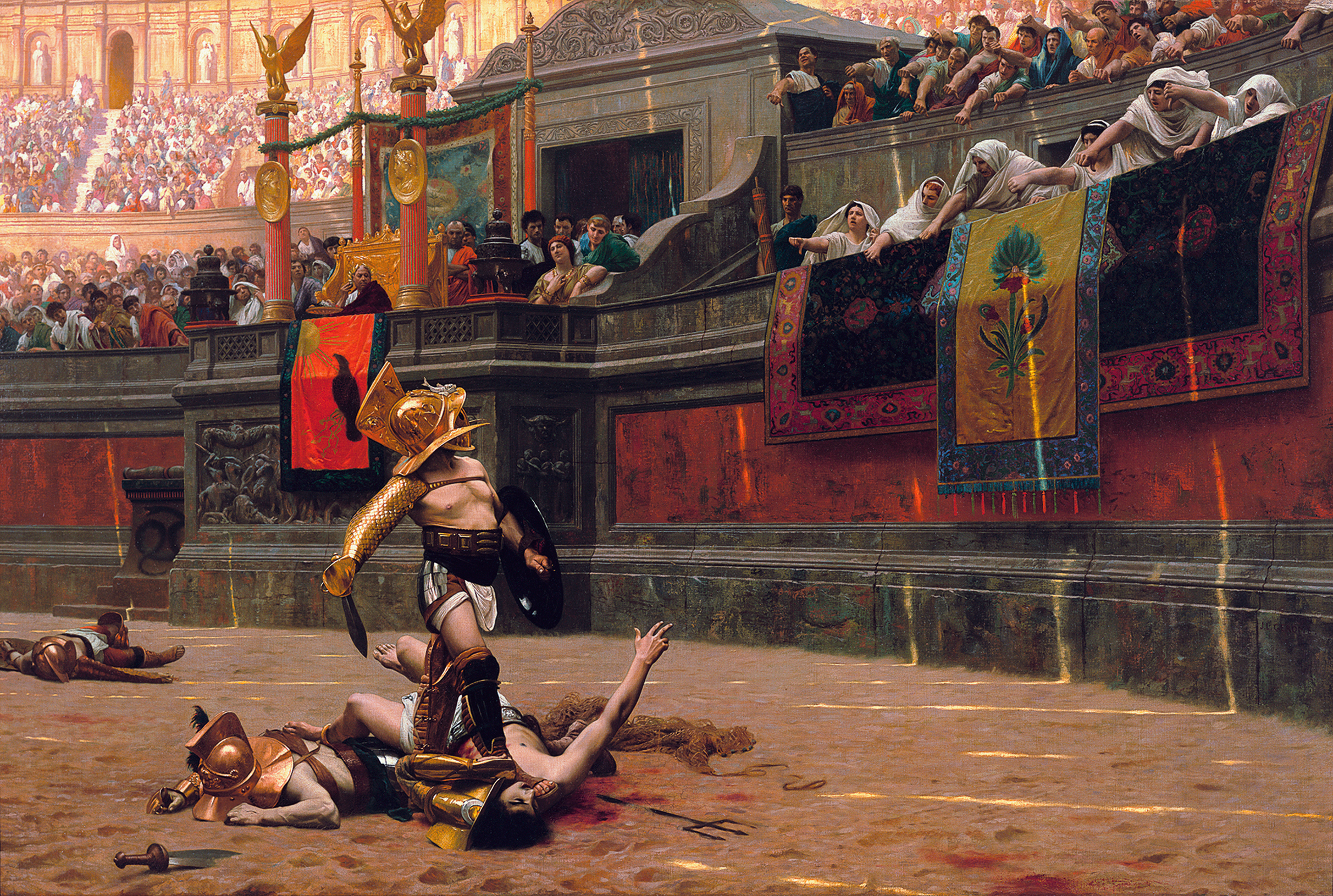
If a work of art is all about the concept behind it, then this was one of the most successful works of art in the year 2000. This image was the inspiration for the film Gladiator, directed by Ridley Scott and starring Russell Crowe and Joaquin Phoenix. It was a box office smash, it dominated the Academy Awards, and it ushered in a new era of high-production sword-and-sandal and fantasy dramas. But the artist that created this image that got Ridley Scott “hooked” on the idea never got to see the movie. He never heard that Scott found the image so compelling. In fact, the artist, a French painter named Jean-Leon Gerome, died nearly a century before that. This image was painted in 1872, and it looks just as awesome, dramatic, and inspired today as it did then.
Gerome was a giant in the art world. Today, scholars consider him perhaps the most famous artist in the world in his own time. He taught literally thousands of students at the most prestigious institutions in Paris. He painted literally hundreds of paintings, many with dozens of figures each in historically accurate costumes. He was tireless, adventurous, innovative, and highly skilled at composing and rendering stunning scenes that look fully real, yet were conceived in his imagination. His work, to judge by those five Oscar wins in the year 2000, is still massively influential.
So why do so few people know about this image and the artist behind it? At the end of his career, Gerome and his peers were already being slighted by some art writers. By the early 20th century and lasting until our own time, they were largely omitted from mainstream art writing altogether. Can “history,” so called, deny mentioning the leading figures of an era?
We can do better – we can understand the historical record. Let’s get familiar with the time and place in which this was painted. Let’s look closely at how and why Gerome chose this concept and how he created it. Let’s seek to understand why it continues to be so compelling today.
The Time: Late 19th Century France
History painting was considered the highest achievement of fine art in Europe for centuries.1 It required a sophisticated set of technical and scholarly skills. It helped preserve history and illuminate it for a new generation. It told the people of a nation who they were, and it embodied the values they stood for, or at least, those they aspired to. We still recognize some of these symbols today (Michelangelo’s David, Raphael’s School of Athens, David, The Death of Socrates). They are not merely oddities or priceless commodities. They are expressions of a culture that continue to speak to us about who they were and what they stand for. We have some of them, too: The Statue of Liberty, the photos of Abraham Lincoln, the Minute Man statue, the Lincoln Memorial, paintings of the Declaration, Washington Crossing the Delaware, MLK speaking at the Lincoln Memorial, the moon landing. All of these were carefully crafted to communicate powerfully to millions of people. Unfortunately today a lot of effort is being put into denying the existence of or outright destroying monuments. While some of this is justified because we now villify the subjects of those works, some of it not so noble, and is owing more to ignorance of the past than a virtuous iconoclasm. It is easy to deface or tear down a monument. It is hard to make a better one.
To do that, we need education and training. That is precisely what the Paris school did, and other national schools followed the example, producing most of the great artists, scholars, and educators of those centuries.
The training was rigorous, the stakes and the rewards high.
The richness of the training and aculturation in the classical world inspired many to interpret contemporary incidents using themes from classical antiquity. There are elements of allegory that audiences would have readily understood, as they used historical and archetypal characters to show the themes, attitudes, motivations, and actions in dramatic settings to illustrate the parallels between the historical situation and the situation in their own time. This is easiest for us to recognize today in the fields of illustration, filmmaking and graphic novels, since they are the main inheritors of this tradition, while, strangely, the gallery art of the past century largely refused it. I say strangely because painting and sculpture have a very great capacity to express narrative and lifelike illusion, yet it was seldom utilized to its full potential after the 1920s.
Gerome, the Technician
Perhaps the main reason why this became so rare is its demands upon technique. Every generation has important stories to tell, but to create complex scenes that make the viewer feel like an eyewitness, technical training was the first and most demanding requirement. The technical training Gerome received enabled him to tell those stories in that way, and it followed a tradition through master to apprentice that had been in place at least since the Italian Renaissance. Gerome’s talent was recognized early in life, and his early drawing teacher was Claude Basil Cariage, a Neoclassical painter and former student of Jean-August-Dominique Ingres. In 1840 at the age of 16, Gerome went to study with Delaroche, eventually travelling with him to study in Italy in 1843. Thus Gerome’s artistic lineage was a venerable one – besides a line back to Ingres it also traced three steps back to Jacques-Louis David through Antoine-Jean Gros and Paul Delaroche. In this line we can also see the dance among several influences that proceeds through the history of western art: conceptual invention, borrowing from precedent, and empirical observation.
In the early 1800s, the form was dominated by conceptual invention. Theatrical and dramatic, the paintings read like scenes in a play, with actors using heightened gestures and expressions. Even scenes ostensibly set outdoors were instead practically staged in the studio. This approach was attested to by David’s early teacher François Boucher, who said that nature is “trop verte et mal éclairée” (too green and badly lit.)
Jacques-Louis David was initially taught by Boucher, a major example of the Rococco. However, Boucher, perhaps recognizing a change in tastes away from his own style, eventually sent his pupil to study with Joseph-Marie Vien, who instead embraced borrowed from the precedent of classical antiquity.
David would, in turn, work from classical precedent and move toward empirical observation. David is best known for high neoclassical works such as The Oath of the Horatii and The Death of Socrates. For these subjects, David relied on his study of antiquity, and the final products retain much of this marble smoothness and monumental hyperreality. But in other works it is evident that David also did close observation of the model, as in his study Patroclus and the male nude titled Hector’s Body. The gesture, anatomy, and foreshortening all have the immediacy and accuracy of careful academic study from life.

David’ student Antoine-Jean Gros would continue in this vein, though his output was inconsistent. In his large history and genre paintings, his draftsmanship and paint handling are at times considerably looser than David’s, and his quotations are not strictly classical and rather awkward. He seems to seek drama from gestures borrowed from Michelangelo’s Sistine Chapel frescoes rather than posing models in his own studio. The results look like bad cutouts. On the other hand, his greatest skills seem to have been in structural anatomy and especially portraiture, in which several of his subjects have an immediacy and candor that bears comparison with anyone of the era.
In terms of history painting and the handling of complex compositions, Gros was clearly surpassed by his student Paul Delaroche. This is evident in Delaroche’s paintings such as The Victors of the Bastille in Front of the Hôtel de Ville and The Execution of Lady Jane Grey. In these works Delaroche sought to appeal to new sensiblities by creating a more nuanced combination of drama and realism. While the setting, lighting, and composition are carefully designed and theatrical, the postures, gestures and expressions are more natural. In the tradition of his predecessor Jacques-Louis David, Delaroche sought pathos not through intense, operatic characters, nor from borrowed gestures from past masters, but rather through the realistic humanity of the individual people and the immediacy of the moment.
Previous eras would have portrayed the Victors standing proudly, their spoils displayed at their feet, as though ready to deliver a rousing speech on stage. Delaroche instead crowds them in to the frame: many are busying themselves with the burdens of their plunder hoisted on their shoulders, some are staggering, wounded, leaning on their comrades in exhaustion from the struggle. Thus the bristling bayonets and the few exultant figures are given even more power by the contrast with their surroundings. They stand out from the bustle, burden, and pain around them. Similarly, Delaroche’s Jane Grey is not the stoic heroine of her own legend but a human being in a moment of frailty. It is her very delicacy and stillness in the moment that makes us pity her fate. This was a new kind of history painting, and it would be imitated all through the second half of the century including by Delaroche’s own pupils, especially Gerome.2

This reimagining of the dramatis personae of the past with a fresh, naturalistic rendering must have lit the fire of passion for craft in young Gerome. Rather than whimsical invention, Gerome developed the habit of making many sketches from direct observation. He did some invention and some borrowing as necessary, but it is clear that he tried to make even those elements look as though they had been directly observed.
Gerome proved this early in his career. In his sixth year of study under Delaroche, he entered his first painting in the Paris Salon: Young Greeks Watching a Cock Fight. Despite it being “skyed” high above eye-level in the room, it received a prize, was purchased, and was publicly lauded by poet and art critic Théophile Gautier.

If we look beyond its sensuousness and the abhorrence of animal fights in our own day, the painting shows Gerome’s remarkable refinement of naturalistic rendering in an invented scene. Perhaps the review Gautier wrote says it best:3
…a charming picture, full of delicacy and originality, by a young man of whom we hear for the first time, and who has just made his début. This subject, apparently trivial, has, under his fine and delicate handling of crayon and brush, taken on a rare elegance and exquisite distinction. The figures are life-size, and treated in an entirely historical manner. Great talent and resources have been necessary to raise so episodic a scene to the rank of a noble composition.
Beside the pedestal of an exhausted fountain, where a marble sphinx shows its disfigured profile, surrounded by the luxuriant vegetation of a warm country, arbutus, myrtles, and oleanders, whose metallic leaves stand out against the azure of a placid sea, separated from the azure of the heavens by the crest of a promontory – two young people, a youth and maiden, are engaging in combat the courageous birds of Mars.
The young girl leans upon the cage in a pose full of grace and elegance. Her beautiful tapering hands are crossed and charmingly disposed; one of her arms lightly presses the budding breast, and the torso has that serpentine curve so sought for by the ancients; the foreshortened limbs are skillfully drawn; the head – crowned in exquisite taste by a coronet of blond hair, whose fine tones contrast softly with the skin – has a childish delicacy, a virginal sweetness; with lowered eyes and mouth parting in a smile of triumph – for her cock appears to have the advantage – the maiden regards the struggle carelessly, sure that her wager is won.
Nothing can be more beautiful than this figure, whose only covering is a fold of white and yellow drapery, held in place on the sloping contours by a slight purple cord; this grouping of tints, very soft and very harmonious, admirably sets off the warm whiteness of the young Greek’s body.
The youth – whose locks are adorned with a hastily twined wreath of leaves plucked from the neighboring bushes – is kneeling and bending toward his cock, whose courage he endeavors to stimulate. His features, although reminding one perhaps a little too much of “the model,” are drawn with remarkable skill; we can see that he is utterly absorbed in watching the phases of the combat.
As to the fowls, they are real prodigies of drawing, animation, and color; no other artists who paint animals have attained, after twenty years of labor, the perfection Mr. Gerome exhibits at the start. Black and lustrous, with greenish reflections, the neck bent, its triple collar of feathers bristling up, the eye full of fury, the crest bleeding, the beak open, the claws drawn back to the breast — one of the cocks, no longer touching the earth, darts forward, presenting to its adversary two stars of threatening claws and formidable spurs – a marvel of pose, drawing, and color.
Not less worthy of admiration is the cock of the coppery, reddish-tinted plumage, which, drawing back close to the ground, lifts its head craftily and extends his beak like a sword, upon which his too fiery opponent may run himself as on a spit! What is remarkable above all in these fowls is that, besides the most absolute truthfulness, they show a singular elegance and nobility. They are the epic Olympian birds, such as Phidias would have sculptured al the feet ol the god Ares, the savage offspring of Hera.
Children and birds have made of Mr. Gerome’s picture one of the most charming canvases in the exhibition. What a delicious frieze-panel for the banquet hall of a king or a Rothschild!
Other critics also responded well to Gerome’s fresh approach and reliance on observation from nature. Edmond About wrote later, “Greece is the country of simplicity. Mr. Gerome was ‘Greek’ from the beginning, because he was simple.” Gerome himself later reflected that his naturalistic approach must have been a refreshing contrast to the prevailing style at the time.
At this period… there was a complete absence of simplicity. Effect (le chic) was in great favor, when accompanied by skill, which was not infrequent. And my picture had the slight merit of being painted by an honest young fellow, who, knowing nothing, had found nothing better to do than to lay hold on Nature, and follow her step by step, without strength perhaps, without grandeur, and certainly with timidity, but with sincerity.
According to Gerome’s own memoir, following this debut he met with mixed success, which attests to the difficulty in creating these effects. Rather than being discouraged and abandoning his careful practice, he persevered and pushed himself to attempt a wide variety of subjects, gestures, lighting, and eventually, more complex and grand compsotions. By 1852, Gerome was able to design and complete a large mural with dozens of figures and a variety of depths in perspective titled The Age of Augustus, The Birth of Christ.
Let us turn now to the gladiatorial arena, but pause first to view another painting by Gerome, Ave Caesar! Morituri te salutant. The title refers to Gerome’s broad interpretation of a phrase recorded by Suetonius, translated as “Hail Caesar! We Who Are About to Die Salute You!” While based on a single account that may have borne little resemblance to the scene depicted, this phrase is an enduring summary of the spirit of gladiatorial combat – it was also carried over into Ridley Scott’s film.

While the composition of a theater stage tableaux requires some management of perspective, the challenge becomes much greater as the space grows. Placing accurate features and figures at vastly different distances in a scene such as an arena requires much preparation. A composition like this would have been impractical to stage using photography, and even today it presents many challenges for computer graphics. Instead, Gerome’s technical ability allowed him to use the science of perspective to combine his field studies of the colosseum with figures and elements including figurative statues at scales, distances, and rotations that add up to an entirely convincing illusion of an eye witness to the event. His careful observation and accurate rendering of form are evident at the minutest scale and in very different settings, lighting conditions, perspectives and positions.
Gerome, the History Buff
The elements that Gerome has gone to great lengths to place in his painting are no less carefully considered in and of themselves.
Gérôme liked to present panoramic visions that took in not only foreground figures and faces, but entire crowds, grand architecture, cultural iconography and setting. Both critics and the public were astounded by the results of Gérôme’s meticulous research. He constructed his building using architectural drawings of the Colosseum, made studies of models in gladiator costumes with weaponry, and even included the web-like structure that held up the awning protecting the richer members of the audience from the Roman heat.4,5
We have to bear in mind that while Gérôme was scholarly and meticulous in his research, his work should not be mistaken for a literal historical document. For example, a criticism at the time was that the lazy glutton emperor Vitellius had not been in power for over a decade before the Colosseum was built. As we will discuss later, his primary purpose was not to create a literal historical record. Rather, his works were in fact quite progressive and a considerable departure from the tradition of history painting. His works have commonalities with the historical fiction and period dramas that came after.6 Art historian Laurence des Cars noted that though a “certain kind of history painting was indeed dead”, the new animation of “narrative and images […] had only just begun,” and Gérôme was in the vanguard.7
Now we come to the painting in question. Let’s look first at the entire image of Pollice Verso.

Now, let’s “read” the painting by zooming in on a few details.
The architecture, as in the previous work, is meticulously detailed and accurate to the historical structure, which Gerome must have seen in person during his time in Rome. He even includes statues of gods and goddesses in the niches between the doorways, and varies the cast shadows of the spectators lending naturalism to even the farthest reaches of the background.


Instead of swagging fabric at the top as in the last painting, Gerome now uses the retractable velarium awning as a compositional device, dividing the plebeans roasting in the sunny background from the patricians enjoying the moodier shaded foreground. The canopy shows its presence only by the size of the lit sections and a few rays of light slicing the shade on the ground and running up the walls.


The emperor’s pose and expression are telling. While many in the crowd are riveted by the moment, and the patricians and priestesses are wildly gesturing, the most powerful man in Rome seems less interested in the decision than the snack he’s eating. In his previous gladiator scene, Gerome labelled the emperor as Vitellius, one of the short-lived rulers in AD 69, a year plagued by civil war known as the Year of Four Emperors. Vitellius’s record was one of wantonness and disregard for Roman lives.

Otto, his first rival for the empire committed suicide to avert a civil conflict. By contrast, when Vitellius heard that another upstart was marching on Rome, he compelled his forces to fight against their fellow Romans, and fifty thousand died in the battle for the city. When he was finally ousted, he died pitifully and violently, being torn apart in the streets and pleading with his assailants that he had “once been their emperor.” Vitellius was emblematic of the worst kind of autocrat, and he was chosen a few years prior by Thomas Couture’s The Romans in their Decadence, displayed in 1847, shortly before the 1848 Revolution toppled the monarchy in France. It’s likely that Gerome includes Vitellius here again for similar reasons, only a touch more comic.
We should now consider the foreground combatants themselves. The three figures correspond to two types of gladiator, murmillo – named for the Greek mormyrus fish, and retiarius – the net-man or fisherman.

The triumphant murmillo has many of the characteristic historical features:
- balteus: a leather belt adorned with decorations like a modern boxing title belt
gladius: the sword for which gladiators themselves were named - manica: arm guard, sometimes covered in scales like a fish
- ocrea: metal shin guards
- fasciae: padding under the ocrea
- cassis crista: adaptation of a Boeotian helmet with ornate grill visor.
One change, perhaps for the aesthetic alone, is the round aspis shield instead of the rectangular scutum shown in ancient sources. Another is that the matchup of murmillo and retiarius was more common after the period shown here.
The helmet is of special interest – like the historical artifacts show, these were oornate and complex pieces that evolved considerably over time. Gerome seems to get the period of this helmet just about right – the basic structure has a considerable amount of metal extending the brim to protect not only the head but also the neck and part of the shoulders. The decorations are elaborate, with a Medusa mask, several figures, and a fish in contrasting metal prominent on the front.

All of these elements were fairly common for this helmet type, with the exception of the full-relief fish which was more rare. The pointed extensions past the cheeks are probably invented, and may be artistic license. There are extant examples of helmets from this period in Pompeii, though Gerome may have derived his designs from drawings done by other artists in his own time. The result is a stunning and iconic element that completes the intimidating and almost super-human figure. Today we may think of a cross between a superhero and a combat sports champion. Though the symbolism and the extent of the brutality ws different in their time, this is a useful description of how the Roman public actually saw these gladiators.
The unfortunate retiarius is shown lightly armoured and lightly attired in a subligaculum loincloth held in place by a wide belt. He wears no head protection or footwear and is equipped like a fisherman:
- manica: arm guard
- galerus: shoulder guard
- rete: a weighted net
- fuscina: a three-pointed trident, also called a tridens
- pugio: short dagger (not shown in the painting)

Gerome has correctly shown the retiarius wearing both the shoulder guard and the arm guard on the left arm, since in the fighting stance this side was much more exposed. The right side, by contrast, was less exposed and not armored. Gerome uses these features to create a strong compositional and narrative device.
Gerome, the Dramatist
Let’s look at the drama Gerome creates by orchestrating the gestures of his actors into a striking composition.
First, the impending violence in the foreground. The triangle of limbs near the doomed man’s face are all covered in armor, surrounding and pointing to the face contorted with pain.

Meanwhile, the opposing twist of naked limbs heightens the writhing and unprotected state of the pinned fighter pleading for his life.

The part of the crowd to which the retarius pleads provides the dramatic compliment to the scene on the sandy floor. Gerome infuses these characters with drama, irony, and a commentary on the moral decline of the people. This inclusion, as much as the dramatic fighters entangled in the arena, takes Gerome’s treatment of the ancient gladiator to a new height of visual rhetoric.
A glance back at the earlier work shows the difference. This painting was popular at the time, but the area on the canvas is dedicated more to technical flourish than emotional resonance. The crowd is too distant, the visual interest too scattered. There is something to be said for the contrast of the proud group of fresh fighters standing among staff casually clearing the dead from the previous bout. The fine detail of the canopy with its pattern of decorations and web of ropes is impressively constructed. However, the details do not add up to a singular clear message.
Here, Gerome is more selective. The sweep and grandeur of the scene are still here, but the focus builds as we move toward the foreground, and we follow the lines of sight and gesture between the fighters and the foreground crowd. The interaction is practically audible. The rest of the arena is hushed as the majority of the crowd holds its breath, but the jeering of the nobles and the shrieks of the Vestals make even the portly emperor turn his head away from his eating hand.
This is emphasized with another compositional triangle of emperor, Vestals, and foreground gladiators. The effect of reading the painting is thus like the “bullet time” super slow motion effects at the dramatic moment in a big-budget action film.
The motif of the Vestal Virgin was a powerful classical parallel to the pietistic Virgin Mary for centuries in Europe. The ancient Vestal Virgins were chosen from childhood, enjoyed incredible privileges, and were so protected that their persons were inviolable on pain of death. Conversely, their own breach of conduct by giving up their chastity was punishable by being buried alive. Stories of their purity acquired mystical reverence, such as the story of Tuccia, a Vestal who was wrongfully accused of breaking her chastity and proved her innocence by carrying water in a sieve. These sacred associations were used to honor women in portraits throughout the centuries after the Renaissance. In one example, the Virgin Queen Elizabeth I of England is shown holding a sieve to evoke the noble comparison.

Their depiction since classical times was reserved, posied, modest, chastely beautiful. Gerome was careful to retain the important symbolism of their attire, the layers of white fabric signalling their modesty, purity, and inviolability. But this is where the similarity to previous depictions end.

This new depiction of the Vestal Virgins is completely arresting. The nobles calling for condemnation seem placid compared to these ravenous women. Here, Gerome’s sense of drama crescendos to the fullest. He has turned them into wild creatures, as daring a transformation as Bernini’s Saint Teresa. Their bloodlust is as palpable as Teresa’s bodily ecstasy, and, in the context of their sanctimonious reputation, just as shocking. It is another powerful symbol of the degeneracy of the Romans; it is them whom we can blame for the callous murder of the vanquished man lying helpless in the sand, even while he cries to them for mercy.

Finally, we come to their gesture – the gesture for which the painting was named: Pollice Verso, which translates as “With a Turned Thumb.” Is this, in fact, the gesture the Romans used to condemn the gladiator to death at the hands of his conqueror? This point has been contested ever since the painting’s debut, and a pamphlet of some 49 pages of correspondence by scholars regarding the question was published in 1879. The conclusions of scholars today are as uncertain as the conclusions then, but in general a thumb “turned” out and away from the rest of the hand to indicate death seems plausible. In an historical sense Gerome’s use of the gesture is guilty of nothing more than conjecture from incomplete evidence.
More importantly, what does the visual impact of this particular thumbs-down gesture say about Gerome’s choice? The posture of the victor is strong and clear – though the hand is shielded by the guard, we know that it is turned with the thumb down as he holds the point of his gladius just above the neck of the vanquished – in fact the whole armored hand and blade take the shape of a giant hand and thumb. Thus it simultaneously threatens and points to the man on whom judgement is being passed. The gesture of those in the crowd is therefore chosen to mimmic the gesture of the victor. Though the gladiator’s blade is arrested for a moment, the crowd viciously gestures for the short thrust that will finish the job. It’s the shortest physical distance between the verdict and the execution, and it is as though the crowd is pantomiming the action they call for – they goad him to imitate them in return.

Thus death hangs suspended in the air, and a mere gesture of the crowd is all the motivation the gladiator needs to rationalize murder. The work is truly a masterpiece, bringing together the enormous crowd, the dramatic light and shadow, the reactions of the spectators, and the tense moment of decision. Poet and art writer Émile Bergerat expressed it this way:
The scrupulous exactitude of the slightest details contributes so greatly to the effect of the imagined scene that it is adorned with the certain definiteness which renders a thing absolutely seen so impossible to forget, so unchangeable, created for all time. It is the ideal of success in Art.
Reception and Influence
The painting was purchased at a price of 80,000 francs, a new record price for Gerome. It was bought by Alexander Turney Stewart, a New York merchant that enjoyed success in selling clothing and household goods. Incidentally, his impressive Manhattan retail stores and nationwide business of shipping goods for free made him both in terms of wealth and the nature of his trade the Jeff Bezos of his day.
Bergerat recognized Gerome’s scholarly approach to painting, but understood that it was subordinate the Gerome’s artistry:
Erudition plays a great role in the work of the master, and all that he says of the exactness of his casques and armor for his gladiators applies, equally, to all the paintings he has signed, especially during later years. I find the modern naturalism, so peculiar to all the great minds of our time, in this insatiable passion for archaic truth which distinguishes the productions of this painter. But I had always believed that in Gerome the ethnographic gift took the place of scientific acquirement, and that Nature had done everything for him. It remains proved henceforth that not only has he the instinctive sense for the antique, but that he possesses it as a scholar who keeps posted in all the discoveries of critical history. What distinguishes him from the scientist, and constitutes in him the artist, is that he subordinates the document to the idea, and not the idea to the document. From this — point of view, the painting called Pollice Verso is not only his chef-d’oeuvre, but a chef-d’oeuvre.
Several years after the painting, Gerome would take up sculpture and exhibit his first piece based on the central gladiator figures.

Charles Blanc would write:
It is a great art and at times one is tempted to believe it the greatest of all, because it is at one and the same time like the reality and far superior to nature, substantial and ideal, palpable and divine.
In later years, when Gerome had revealed, by the most varied masterpieces in marble and bronze, his marvelous powers in this new sphere, we have heard him say more than once, with a sigh of mingled regret and satisfaction, “Ah! I was born to be a sculptor.” and he had lived more than fifty years before being able to give reins to his grande passion! One ot the most touching souvenirs in our memory is furnished by his description of his timidity in undertaking this first group, His preparations for it lasted a year, and he scarcely ate or slept after having once begun to mold the clay. He worked with desperate energy, trembling, hoping, fearing, and at last the mighty group was cast in one piece, producing a chef-d’oeuvre that placed the artist, with one stride, in the front rank of the sculptors of this century. Though tempted by munificent otters, he has many times refused to part with this, his “firstborn,” as he laughingly calls it, which won for him his first medal for sculpture.
The influence of Gerome and his work would endure, despite the deliberate obfuscation of skilled artists in popular art history books following his death. In addition to the enduring influence of his paintings, his many students included Mary Cassat and Thomas Eakins, and the drawing course he developed with his student Charles Bargue was a vital element in the late 20th century revival of the atelier movement and a return to technical training in the fine arts.
- This article is concerned with the history of art in Europe and North America, and any general statements should be viewed within that context. ↩︎
- victorianweb.org/painting/france/delaroche.html ↩︎
- The quote that follows is paraphrased. ↩︎
- theartstory.org/artist/gerome-jean-leon/ ↩︎
- Yale University Art Gallery, Lecture 11 – History at the Academy & the Salon: Jean-Léon Gérôme’s Ave Caesar! Morituri te salutant, via YouTube, https://www.youtube.com/watch?v=zUhiz3BFWYA ↩︎
- It is notable how little scrutiny Hollywood receives for a neglect of historical accuracy while these paintings crafted with so much research and care are seldom discussed for little else. ↩︎
- theartstory.org/artist/gerome-jean-leon/ ↩︎

Leave a Reply