Artists created some of the most enduring memorials of major events in the American Revolution. These iconic works are evidence of the training, scholarship, and patriotic fervor these painters and sculptors possessed. But for some of the creators, they were not simply inventing from imagination – they themselves witnessed and lived through the events they depicted.
The Battle of Quebec – 13 September 1759

The first painting in this series, while not showing an event of the Revolution itself, depicts a North American conflict of the same era, The French and Indian War. More importanly, it was painted by Benjamin West, teacher of John Trumbull.
Benjamin West was a colonial subject raised in Pennsylvania who trained in Italy and settled in England. Seized by the moment of frenzied admiration of General James Wolfe, he painted his scene of the Battle of Quebec as a memorial to that fallen hero. The work would bring him fame, fortune, and immortality as the creator of perhaps the most famous painting of 18th century England.
Wolfe was sent by British Secretary of State William Pitt to take the city of Quebec and gain access to the vital waterway of the St. Lawrence River. Unable to engage the French during the summer campaign season, by September Wolfe was concerned that the onset of winter would spell an icy disaster for British ships. Taking the bold decision to ascend the steep cliffs approaching the city under cover of darkness, Wolfe led his forces on an assault on the Plains of Abraham just outside the city. In a battle that lasted little more than an hour, the British were victorious, but Wolfe had taken enemy fire and was wounded unto death.
West’s effort to memorialize Wolfe set a new standard for history painting by trading the conventional ancient setting for a contemporary one. West abandoned the long-established practice of depicting even modern historical subjects as Greco-Roman allegory and staging them with ancient mediterranean landscapes, architecture and clothing. The decision to instead anchor the narrative firmly in present-day impressed the thousands who flocked to see his martyr-like depiction of their war hero. While his stated intention was to show the “facts of the transaction,” he did take liberties to include figures who, while not present at the scene, represented the ethnic and geographical reach of the new British Empire.
To heighten the impact of his painting, West borrowed from another tradition of representation, composing his scene like the Lamentation of Christ. The theatrical lighting, poses, and lifelike rendering combine to give a similar effect. Wolfe’s place in the spotlight echoes Christ, the surrounding officers are his disciples, their expressions of grief and sorrow a pietistic response to a noble sacrifice. West’s dramatic composition imbued the subject with a symbolism and emotionalism that set it apart from its predecessors, thrilled his audiences and bolstered the national, imperial, and colonial spirit in Britain.1
Battle of Lexington – April 19, 1775

William Barnes Wollen was an English history painter born in Leipzig on 6 October 1857.He was educated at University College School in London from 1871 to 1873 and also at the Slade School. From 1879 until 1922, he exhibited pictures at the Royal Academy and National Watercolour Society.
The Battles of Lexington and Concord, on April 19, 1775, were the initial skirmishes between British regulars and American provincials, marking the beginning of the American Revolution. Acting on orders from London to suppress the rebellious colonists, General Thomas Gage, recently appointed royal governor of Massachusetts, ordered his troops to seize the colonists’ military stores at Concord. En route from Boston, the British force of 700 men was met on Lexington Green by 77 local minutemen and others who had been forewarned of the raid by the colonists’ lines of communication, including the ride of Paul Revere. It is unclear who fired the first shot. Resistance melted away at Lexington, and the British moved on to Concord. Most of the American military supplies had been hidden or destroyed before the British troops arrived. A British covering party at Concord’s North Bridge was finally confronted by 320 to 400 American patriots and forced to withdraw.2
Battle of Bunker Hill – June 17, 1775

“The Battle of Bunker Hill” was painted in 1897 by Howard Pyle and published in Scribner’s the next year. Depicting the 52nd Regiment of Foot advancing up Breed’s Hill, the painting was in the Delaware Art Museum until it went missing in 2001 and is presumed stolen (…!) The painting displays the intimidation of the British Army, not just because of superior numbers, but their impressive order, regimentation, and discipline.
British Commander-in-Chief General Sir Thomas Gage was under pressure to quash the colonial rebellion. By June, he had reinforcements and was ready to implement a new strategy. The British Army planned to launch an attack against the Americans on the heights north and south of Boston. Details of the attack were leaked, however, and a detachment of 1,000 Massachusetts and Connecticut soldiers—more of an armed mob than a military unit—gathered to defend a hill in Charlestown. Among the defenders were several enslaved and free African Americans. The American provincials were low on ammunition, disorganized and inexperienced, but held a strong defensive position.
Led by General William Howe, the British troops climbed Breed’s Hill in perfect battle formation. Legend has it that as they advanced, American officer William Prescott cautioned his men not to waste their powder, exclaiming “don’t fire until you see the whites of their eyes.” When British troops neared the redoubt, the patriots unleashed a withering volley, creating an absolute slaughter. One patriot remarked afterward, “They advanced toward us in order to swallow us up, but they found a choaky mouthful of us.” The repulse was a bloodbath, and the British retreated back to their lines.
Once more the British pushed up the hill, stepping over the bodies of their dead and wounded comrades who lay “as thick as sheep in a fold,” right into another devastating patriot volley. Finally, on the third try –as the patriots ran out of powder and shot—the British succeeded in breaking through. After intense hand-to-hand fighting inside the fortification, the British were victorious with heavy losses. According to contemporary accounts, a “black soldier named Salem” killed British Maj. John Pitcairn, the officer despised for allegedly ordering his men to fire on patriots during the battle of Lexington and Concord weeks earlier.
The battle was a tactical victory for the British, but it was a sobering experience. The British sustained twice as many casualties as the Americans and lost many officers. After the engagement, the patriots retreated and returned to their lines outside the perimeter of Boston. The American patriots were defeated at the Battle of Bunker Hill, but they proved they could hold their own against the superior British Army. The fierce fight confirmed that any reconciliation between England and her American colonies was no longer possible.34

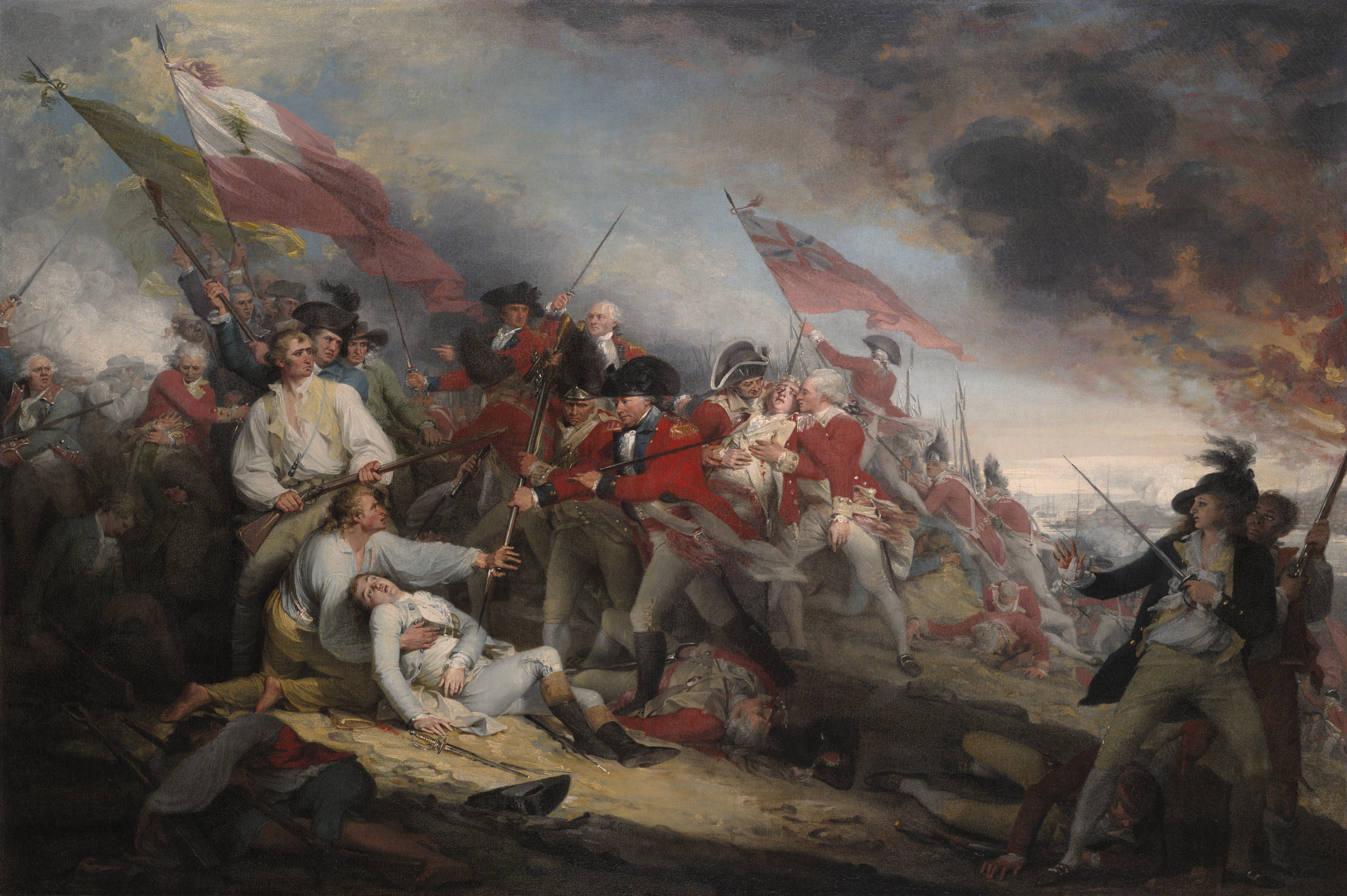
John Trumbull, “The Battle of Bunker’s Hill, June 17, 1775,” 1786, oil on canvas, 25 ⅝ in x 37 ⅝ in, Trumbull Collection, Yale University Art Gallery
John Trumbull (June 6, 1756 – November 10, 1843) was an American painter and military officer best known for his historical paintings of the American Revolutionary War, of which he was a veteran. He was born in Lebanon in Connecticut Colony to Jonathan Trumbull and Faith (née Robinson) Trumbull. His father served as governor of Connecticut from 1769 to 1784. Both sides of his family were descended from early Puritan settlers of Connecticut. Trumbull entered the 1771 junior class at Harvard College at age 15 and graduated in 1773.
Trumbull rendered a particular military service at Boston by sketching plans of the British and American lines and works. He was appointed second aide-de-camp to General George Washington, and in June 1776, deputy adjutant general to General Horatio Gates. Trumbull resigned from the army in 1777 over a dispute regarding the dating of his commission which would have blocked him from further promotion.
In 1780, a financially struggling Trumbull decided to work as a professional artist and sailed to London, where he was introduced to Benjamin Franklin. Trumbull studied under Benjamin West, whose influence is clearly seen in the above work. West advised Trumbull to paint small pictures of the American Revolutionary War and miniature portraits. He painted about 250 such portraits in his lifetime. He also painted the portrait of Washington from memory during this time.
However, due to Anglo-American hostilities, his future remained uncertain. On September 23, 1780, British agent Major John André was captured by Continental Army troops in North America; he was hanged as a spy on October 2, 1780. After news reached Great Britain, outrage flared and Trumbull was the object of retaliation. He was arrested for treason, since he was known to be an officer in the Continental Army and of similar rank to André. Trumbull was imprisoned for seven months at Tothill Fields Bridewell in London.
Even upon his release, he was ostracized from British society for the remainder of the war, but was able to return after the conflict to continue his study with Benjamin West. He also traveled to Paris and befriended Thomas Jefferson, who was then American Minister to France.
Known as The Painter of the Revolution, Trumbul painted many portraits of prominent American Founding Fathers and historical scenes from the conflict.
The above painting of the Battle of Bunker Hill is especially interesting as the artist John Trumbull personally witnessed the event. This painting depicts the death of Founding Father Joseph Warren at the June 17, 1775, Battle of Bunker Hill during the American Revolutionary War. Warren, an influential Massachusetts physician and politician, had been commissioned as a general but served in the battle as a private. He was killed during or shortly after the storming of the redoubt atop Breed’s Hill by a British officer.
Trumbull created an entire series of Revolutionary War images, and he began with Bunker’s Hill to commemorate the battle he considered to be the earliest important event in the war. His focus here is not on the outcome of the encounter at Bunker’s Hill but on the noble behavior of the participants. Set under a blackening smoke-filled sky and against a chaotic background of dead and dying men, he depicts the climactic moment when American Major General Joseph Warren is mortally wounded by a musket ball just as the British successfully press beyond American lines. A bayonet is pointed by a grenadier who wants to revenge his own fallen officer, but British Major John Small grabs the blade and saves the expiring Warren from being stabbed. The expressions on the faces of the surrounding American soldiers and the two departing figures at right, Lieutenant Thomas Grosvenor and his black servant, combine concern for the dying Warren and astonishment at the actions of Small. Trumbull lived a life personally tossed about by the conflict between the two nations. However, he also spent years studying and establishing lasting friendships with Americans and Britons alike. In this painting, Trumbull’s choice of this moment of humanity between enemies honored the brotherly love he witnessed that transcends nations.
Trumbull painted several versions, including the one held by the Museum of Fine Arts, Boston (dated between 1815 and 1831). This was commissioned by the Warren family and passed down through the family before being acquired by the museum. Another, larger version (dated 1834) is held by the Wadsworth Atheneum in Hartford, Connecticut. Trumbull sold the engraving rights for both this painting and The Death of General Montgomery in the Attack on Quebec, December 31, 1775, which resulted in a highly successful subscription release that greatly enhanced his career.5
The Declaration of Indepdendence
July 4th, 1776

This painting depicts the moment on June 28, 1776, when the first draft of the Declaration of Independence was presented to the Second Continental Congress. The document stated the principles for which the Revolutionary War was being fought and which remain fundamental to the nation. Less than a week later, on July 4, 1776, the Declaration was officially adopted; it was later signed on August 2, 1776.
In the central group in the painting, Thomas Jefferson, the principal author of the Declaration, is shown placing the document before John Hancock, president of the Congress. With him stand the other members of the committee that created the draft: John Adams, Roger Sherman, Robert Livingston and Benjamin Franklin. This event occurred in the Pennsylvania State House, now Independence Hall, in Philadelphia.
This is the first completed painting of four Revolutionary-era scenes that the U.S. Congress commissioned from John Trumbull (1756–1843) in 1817. It is an enlarged version of a smaller painting (approximately 21 inches by 31 inches) that the artist had created as part of a series to document the events of the American revolution.
When Trumbull was planning the smaller painting in 1786, he decided not to attempt a wholly accurate rendering of the scene; rather, he made his goal the preservation of the images of the Nation’s founders. He excluded those for whom no authoritative image could be found or created, and he included delegates who were not in attendance at the time of the event. In all, 47 individuals (42 of the 56 signers and 5 other patriots) are depicted, all painted from life or life portraits. Some of the room’s architectural features (e.g., the number and placement of doors and windows) are approximate, having been based on a sketch that Thomas Jefferson produced from memory in Paris. Trumbull also painted more elegant furniture, covered the windows with heavy draperies rather than venetian blinds, and decorated the room’s rear wall with captured British military flags, believing that such trophies were probably displayed there. The exhibition of this small painting (now owned by the Yale University art gallery) was instrumental in securing for the 61-year-old artist a commission to create monumental paintings for the U.S. Capitol.
Trumbull created the enlarged painting for the Rotunda between August 1817 and September 1818. On October 5, 1818, the painting was put on public view at the American Academy of Fine Arts in New York. Over the next four months, he exhibited it in New York City, Boston, Philadelphia, and Baltimore; it was in the Capitol early in 1819 and was displayed or stored in various rooms until 1826, when it and Trumbull’s other three paintings were installed in the Rotunda.
Declaration of Independence balances the last of Trumbull’s Rotunda paintings, General George Washington Resigning His Commission. The two paintings are similar in composition, with figures seated and standing in the background. The central action in each is the presentation of papers: here, by Thomas Jefferson; in Washington Resigning, by George Washington. Both scenes take place in the chambers of a civilian legislature, and Trumbull’s use of similar chairs in the two paintings subtly reinforces their relationship.
Trumbull performed the first cleaning and restoration of his Rotunda paintings in 1828, applying wax to their backs to protect them from dampness and cleaning and re-varnishing their surfaces. Throughout the 19th and 20th centuries the painting was cleaned, restored, varnished, and relined. All of the Rotunda paintings were most recently cleaned in 2008.
An 1820 engraving of Declaration of Independence by Asher B. Durand, who would later become a renowned landscape painter, helped to make it Trumbull’s most famous painting. It is pictured on the reverse of the two-dollar bill and has appeared on U. S. postage stamps: a 24-cent stamp in the series of 1869 and two sets of bicentennial stamps in 1976 (a sheet of five 18-cent stamps and a strip of four 13-cent stamps).6
Pulling down the statue of George III – July 9, 1776

A native of Columbus, Ohio, William W. Walcutt (1819-1882) studied painting and sculpture in New York and in Europe. In addition to his success as a history painter, he is known for his lifesized marble statue of Commodore Oliver Hazard Perry from the War of 1812.
William Walcutt’s 1857 painting depicts the destruction of the monument by New Yorkers and George Washington’s troops following a public reading of the Declaration of Independence on July 9, 1776.
The statue of King George III by British sculptor Joseph Wilton was dedicated August 16, 1770, at Bowling Green, at the southern tip of Manhattan.
On the evening of July 9, 1776, after news reached New York of the approval by the Second Continental Congress of the Declaration of Independence, a mob toppled the statue of the British king George III in an act of “symbolic regicide.” According to legend, the pieces of the statue were then sent to Connecticut, where they were melted down and made into 40,000 bullets for the Continental Army. The nationalism inherent in this incident was of great interest to mid-19th-century, pre-Civil War artists, including Walcutt, whose depictions of events related to the 18th-century establishment of the Union served as encouragement in the mid-19th century for its salvation.7

A recreation of the statue of George III (modelled on an equestrian statue of Marcus Aurelius) was made in 2016 for the Museum of the American Revolution in Philadelphia.8
- https://www.tfaoi.org/aa/10aa/10aa128.htm ↩︎
- https://www.britannica.com/event/Battles-of-Lexington-and-Concord ↩︎
- https://www.battlefields.org/learn/revolutionary-war/battles/bunker-hill ↩︎
- https://historicaldigression.com/2011/03/22/howard-pyle-and-painting-the-revolution/ ↩︎
- https://en.wikipedia.org/wiki/The_Death_of_General_Warren_at_the_Battle_of_Bunker%27s_Hill,_June_17,_1775
https://artgallery.yale.edu/collections/objects/41 ↩︎ - https://www.aoc.gov/explore-capitol-campus/art/declaration-independence ↩︎
- https://galleries.lafayette.edu/2019/01/02/william-walcutt-pulling-down-the-statue-of-george-iii-at-bowling-green-n-y-july-9-1776/#:~:text=On%20the%20evening%20of%20July,then%20sent%20to%20Connecticut%2C%20where ↩︎
- https://www.nytimes.com/2016/10/21/nyregion/toppled-statue-of-king-george-iii-to-ride-again.html ↩︎

Leave a Reply