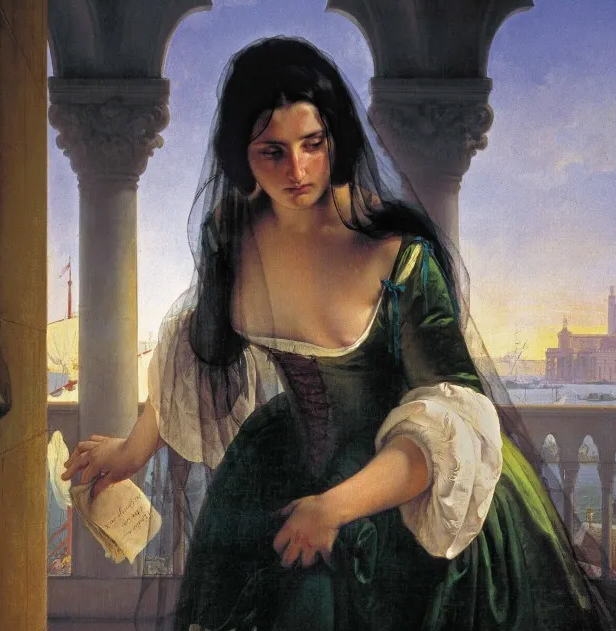
In the late 19th century, Francesco Hayez was one of the most respected painters and art teachers in Europe. His technical mastery of the human figure, carefully controlled form sense, and flair for the dramatic and theatrical still inform the way we envision scenes from Shakespeare and Romantic era writers.
Hayez taught a generation of Italian painters at the Brera Academy, including many who would exhibit at the Paris Salon and win national contests.
Shortly after his death in 1882, The Brera Academy voted to honor his memory and contributions with a memorial monument. The result is a beautiful bronze statue which stands at the Academy today. The statue is atop a plinth with bronze bas-reliefs depicting two of his best known paintings: The Kiss and Le Veneziane (also known as La Vendetta d’una Rivale from the Revenge Triptych).

The following is the speech given by Emilio Visconti Venosta, President of the Royal Academy of Fine Arts of Milan, on February 1st 1890, for the inauguration of the monument to Francesco Hayez.
Today, gentlemen, from the Promoting Committee and from our Institute, is inaugurated, at the doors of this palace, the Monument to Francesco Hayez.
The Academy thought it appropriate to hold on this day its distribution of prizes, delaying it beyond the usual deadlines, to join in this solemnity, to pay homage to the memory of the eminent artist who was, for many years, your Professor, who was President, and whose name is a title of honor for it.
I thank the esteemed Representative of the Government and the esteemed Representative of the City, the Authoritative Personages who honored us with their presence, and you, Ladies and Gentlemen, who have welcomed our invitation, and express our grateful spirit to the city institutes and to the Artistic institutes of Florence, Bologna, Naples, Rome, and the Academies of Rome, Turin and Bergamo, to the Associazione di Belle Arts of Ferrara, who wanted to be represented, and at the Accademia di Venezia, who wanted to be present with one of its deputies, at this our conference.
If Francesco Hayez could attend the honors paid to his name, he would not find them complete without the representatives of Venezia, from his native city. Though he remained, for many years of his life, far away, his thoughts always returned there, and when he chanced to see it again it was with an intimate joy of heart.
The young people who are gathered here have not known Francesco Hayez, not even in the years of his vigorous old age. But your teachers were his disciples, and they who came from his school are many of the skilled painters who hold the field of art in our city.
From the painting of the Laocoön, that won Grand Prize in the 1812 competition of this Academy, to the portrait which, seventy years later, he left on the easel, his productive life had a conspicuous place in the history of Italian art in our times. His name represents a period of transformation and renewal. In painting, his was, for many years, the greatest artistic fame in our country.

Francesco Hayez was born in Venice in 1791.
He is therefore for you, young listeners, an ancestor, and the painter we saw ten years ago, full of enthusiasm for his art, witty and serene, quick in speech and actions, still vigorously maintaining the brush and advising, with an open and benevolent soul, his disciples, occupies with his career the artistic history of a nearly a century.
He grew up and was educated as a child in the home of an uncle who was a businessman and
owner of ancient paintings. The disposition he demonstrated, admiring the canvases that covered the walls in which he grew up, induced him to begin the art of drawing.
Those were unhappy times for Italian painting. The 1700s had been the period of greatest decline for it. Except for some of the best minds of the time, the great Italian schools had for the most part degenerated into a decorative art – the last, poor echo of the distant successors of Pietro da Cortona.
In Venice, however, painting still seemed to draw on for some time – from the old soil some vital juice – and feel the reflection of magical enchantment that surrounds the city of the lagoon.
One could say that Tiepolo, in the last century, with the dreamy fantasy of his color, represented the last pomp of the Republic, while Antonio Canale portrayed the image of ancient Vencie, and Pietro Longhi painted the costumes that Goldoni brought to life on the stage.
But when Hayez was a child, these representatives of Venetian painting had been dead for a quarter of a century.
After them, the students of Tiepolo and also of Piazzetta decayed into the Baroque, while some other artists, without escaping from mediocrity, tried to bring painting back to a more correct style, or began to follow the examples of that school of painting, taken from ancient statuary, which prevailed in the rest of Italy and which in Venice seemed more exotic than elsewhere.
Hayez, at the age of five, and he remembered it, had seen the Doge descend from Bucintoro and the senators with the red togas that he was destined to paint so much later: he saw, on the Piazza di S. Marco, the republican soldiers of France, the Austrians of the peace of Campoformio and, later, the troops of the Kingdom of Italy.

The Napoleonic government favored art, a rather disciplined art, like the rest, which must have contributed to the splendor of a great regime and celebrated, in heroic style, the glories of ancient Rome and of the new Empire. An Academy was founded in Venice, whose
President was Count Cicognara, who represented with honour, at the beginning of this century, historical studies and art scholarship.
Hayez performed his studies there under the guidance of Matteini, a Tuscan, professor of painting, who had been a disciple of Pompey Battoni. And when the Academy announced the competition for the so-called pensions in Rome, Hayez stepped forward and won the difficult tests.
In 1809, at the age of eighteen, the young artist went out for the first time from Venice, and went to Rome, admiring along the way the ancient masterpieces of Italian art and visiting the artists famous in those times.
Painting then followed the precepts of the Frenchman David, who was considered, and rightly so, as the first master of the era, and that he wanted to bring art back to a more virile and stronger ideal, allowing it to speak the Greek and Roman languages, dear to the men of the Revolution and Empire. In this school color and light, expression and truth were sacrificed to the sculptural attitude, to magnificent gesture, to the rigid precision of the outline.
In Florence Hayez entered the studio of Benvenuti, an artist of much ingenuity, who was coloring a great picture before everything was painted in chiaroscuro like a bas-relief. He was well received in Rome by Camuccini, who tempered the harshness of the current system with imitation of Raphael. The young Venetian, who still had in his vision the paintings admired in the churches and palaces of his own city, approached the thresholds of these celebrities with reverence, but he came out, in spite of himself, unsatisfied, and doubts were mixed with respect. He seemed to see, beyond that school, an art in which inspiration was less suffocated by the rule, an art more spontaneous and more alive, with a less harsh and truer complexion.
In Rome, Hayez’s protector was an artist who could be called great in front of every school, Canova, to which Count Cicognara had recommended him, and who became his loving friend and advisor. The schoolboy drew in the Museums, and he remained for a year, enchanted, studying in Raphael rooms, with that dedicated worship of art that accompanied him throughout his life.

Young artists then converged on Rome from all over Europe, they lived in groups with their countrymen, they dressed like Raphael to distinguish themselves from mere mortals, they argued ardently about their ideals, and fights were frequent among the Romantics over who was the greater painter – Camuccini or Landi.
Those who belonged to the Kingdom of Italy gathered in their Academy and competed in artistic exercises. A topic was chosen; after eight days, everyone had to bring a painting or drawing composition on that subject. The judging was between peers; the young people themselves decided and awarded the prize, pronouncing the reasons for their judgment out loud, and then they started again with another topic. Hayez, in his mature age and professor in our Academy, wanted to introduce this competition among his students. But he stopped, complaining that he could not find among them the sacred fire that animated his peers in their time. What would he have said when, a little later, ministerial regulations prohibited any study of composition as a dangerous exercise!
In 1812 Hayez, encouraged by Canova and also Cicognara, who was interested in him from Venice, competed for the grand prize of the Academy of Milan, sending his Laocoön, which can still be seen in these rooms. The painting immediately seemed worthy of being chosen.
But there was another Laocoon not without merit, by De Antoni, pupil of Appiani, who, certainly, had helped the work of the schoolboy. Why displease Appiani? The difficulty was overcome by obtaining two large medals from the Viceroy for that year, but that was not the last of the problems the Academy found itself in when awarding its prizes.

Hayez lived in Rome with the most renowned artists, in that profitable familiarity that unites the young with the experienced. He shook hands with Palagi – a friendship that lasted his whole life. He knew, not to mention many others, Minardi, Pinelli – friends of Ingres– who had a large part in the history of modern French painting. He studied, with an independent spirit, in the midst of these wits and ways, each different but also united by that secret bond which associates, in the eyes of posterity, all the works of an era.
In the seven years in which he lived in Rome, Hayez began and completed several paintings. I won’t mention these, so as not to make too long a speech. They contained the promises of the future – the overall product of the education received and of a temper of ingenuity which, by its own strength, sought greater novelty in composition and color.
But the great events of politics and arms make themselves felt even in the quietest lives. Hayez was painting a great picture representing Ulysses in the Palace of Alcinous, King of the Phaeacians, when the Napoleonic Empire fell, and the cannon of the allies thundered below the atriums where Nausica’s father sat at a banquet.

The young people sent for protection in Rome by the destroyed governments looked to the future with uncertainty. But, just at that point, the Municipality of Venice, to celebrate the fourth wedding of Emperor Francis I, decided to decorate the Royal Palace with works entrusted to Venetian artists. Hayez, whose name was already met with goodwill by his comrade citizens, was among those called. He, who had meanwhile finished the chapter of his youth in Rome by marrying a young girl he loved, saw again his native city, full of hope, content in his affections, in the spirit of those who always have to seek inspiration for art rather in peace than in the storms of life.
He spent three years in Venice, and spent all that time, judging by the commissions he received, in executing many decorative paintings in fresco in public and private buildings. But if these works were useful in giving him practicality and directness, they were still hasty jobs.
The young artist, in his frank and modest conscience, feared getting lost in the easy ways of mannerism, of regressing from the most rigorous studies he had made before. And giving up commissions and profits, he wanted to devote himself to the paintings he conceived, to the study of reality, to the works in which he could express all his favorite forms of thought.

Hayez, now master of himself, had reached that decisive hour, in which an artist, if he has real strength in his ingenuity, the path that he is to travel opens before him. He put aside Greek and Roman subjects, and he chose subjects taken from Venetian history, and thought that if the classical school had freed Italy from the Baroque, it was now necessary to bring painting back to a greater truth. He sought simplicity in composition, freeing himself from the pedantic rules that are the enemies of motion and life; he studied the harmony of colors and the lines as he felt them, without taking into account the usual precepts.
Hayez wanted, at that time, to get to know the artists of the Lombard capital, to see his friend Palagi again. He came, in the summer of 1820, to Milan; he brought his painting with him and showed it to the public at the Brera Exhibition.
Hayez arrived in our city at a good point in time.
Those were the days when the great struggle of the Romantics was raging. Let’s talk about it with respect and affection, gentlemen. The romantics were Manzoni, Grossi, Carlo Porta, Giovanni Berchet, Torti, Ermes Visconti, the most profound critic of the school after Manzoni; they were Silvio Pellico, Borsieri, to whom fate had already tacitly opened up doors of Spielberg.
Though beforehand this select group was dispersed by prisons and exile, these intellects kept alive in Milan a movement of study, of ideas, of aspirations beyond their own city, which had repercussions on all Italian thought: money and business are not enough – there is value in the moral capital of culture and art, science and ideals.
The Romantics, the same ones who longed for a modern, redeemed Italy, demanded for Italian society a literature that expressed the truth of its thoughts and feelings. The abstract and rhetorical types of classicism could dress up some forceful protest or some great anger, but they could not contain the ideas and the affections of modern civilization. Pagan symbolism could still receive a flash of light from the Hellenic soul of Foscolo, but it could not be the living form of those ideals that brighten the feelings, minds and beliefs of our times. The Romantics therefore called for a literature which had as its object that truth which, by affecting both the intellect and the heart, lifts them up and educates them and which recalls the form and expression to simplicity and naturalness.
The love of reality, after many fairy tales and many mythological allegories, attracted Romanticism towards history; Romantic literature was mainly historical and inclined to seek the basis of poetic invention in history.
The great Greek and Roman poets were highly national because they took their subjects in the traditions, which had for them and for their people the value of real events. The Romantics started from this example to argue that the art of our times preferred that much broader field which did not belong to the ancients: the history of the Middle Ages and modern history close to our ideas, to our feelings, united with us by the bond of common Christian civilisation, a living part of our national history.
The recently new and passionate study of foreign literatures played a part in this historical trend of Romanticism. But there was also another and powerful reason. Modern Italy could not remake itself with the thoughts of Timoleon and Brutus. But how many teachings sprang from ancient Italian greatness and misfortune! The inventions of art grafted onto the events of our past could, even in the presence of lesser masters, speak to the living Italy of its pains, its harsh experiences, its immortal hopes.
The historical novel, therefore, the historical drama, were the favorite forms of romantic literature. The historical novel has gone out of fashion today. We now prefer to ask nothing more of history than history and of the novel the description of the society in which we live. The difficulties inherent in the historical novel are well known. It is difficult to breathe life into the customs and characters of distant eras, to give thought and language to the men of other times, and even more difficult to harmonize the unity of the composition with two elements that are not homogeneous with each other, such as the imagined and what actually happened. If history predominates, art is sacrificed; if imagination predominates, it is easy to slip into the conventional and the false.

Alessandro Manzoni, who had to scrutinize these difficulties with such acute criticism, had already overcome them, writing an immortal book, in which everything is true, according to the places and times described and also true according to the general and eternal truth of human nature.
Hayez had not delved into the depths of aesthetic theories and historical stories that were discussed in those times; perhaps he had not read the Conciliator, already suppressed by the Austrian police when he arrived in Milan.
The heroes of classical tragedies were matched by the sculptural and emphatic figures of classical painting, but mythological symbolism was matched by the tasteless allegories of Olympus. As soon as the spontaneous impulse of his genius made its way among the reminiscences that dominated the first years of his youth, he felt that the school in which he had been educated had now become old. And due to that influence that dominates the moral environment of an era, his artistic feeling in painting was in harmony with the artistic feeling that prevailed in the new literary school.
The success achieved by the first paintings exhibited by Hayez in our city was great. Those who aspired to rejuvenate Italian art recognized in them the emancipation from cold academic precepts, the incarnation in painting of their favorite ideas and inclinations.
And Hayez, in turn, found in the reasons for that applause a clearer awareness of what had been suggested to him by a spontaneous feeling of art.
Perhaps the innovation brought about by Hayez was not such an absolute revolution as it seemed at the time; art usually proceeds through evolutions, and if those close to us see the differences well, those far away sometimes see the analogies better, even indirect ones. If, before him, Appiani left among us his noble traditions, if memories of the great genius Bossi remain, if Sabatelli then gave a powerful vigor to design and composition, it must however be recognized that Hayez marked the transition from the classical school that dominated in the first twenty years of this century to modern painting, and that his name will live together with the origins of a transformation which also benefited those who, after him, sought new or different intentions.
He represented Romanticism in art – to say it better, Romanticism as it flourished in Italy. His historical painting portrays the affections, the characters, has the episodic proportions, the poetic preferences, and even the fashions of our historical novel, of which his paintings were sometimes the brilliant illustration.
Now, historical painting is said to be dead. In truth, I would not be able to subscribe to such an absolute declaration. This or that genre of art can be considered exhausted when it is assumed that these genres become, by their nature, fixed at an equilibrium. But they are not. An internal innovative force transforms them. The painting of the historical episode, having had the same raison d’être as the historical novel, will perhaps share its fate. But it would be hard for me to believe that from the past, from this field open to evocative imagination, some great pictorial vision could no longer reach an artist of genius.
The popularity that Hayez’s paintings had was certainly due to their artistic merits, to the undeniable and singular talents of the painter, to the novelty of the manner, of the coloring, which distinguished him among his contemporaries, to his simple compositions, balanced, clearly understood, a harmony of design and lines not disturbed by an overly ardent imagination, a respectful study of truth far from any common or vulgar image. Yet his works also aroused such lively interest when they first appeared because they were the representation of those subjects and those feelings in which the imagination of the public then loved to seek its emotions.
After having paid homage to the head of the new Italian school with the Count of Carmagnola, he took inspiration from Schiller’s scenes of pathos in Mary Stuart, and from Shakespeare, the sad tale of Romeo and Juliet.

The Middle Ages, in which Romanticism sought, with such predilection, the poetic and the picturesque, provided the subject for many of its main paintings. And if Hayez sometimes returned to heroic subjects, to Ajax, and later to Samson, it was to respond to the criticism of those who accused him of only painting small figures and of not knowing how to deal with the difficulties of the nude.
Among the works that illustrated Italian literature at that time, it seemed that his genius followed the invitation of a spontaneous sympathy for the novelistic descriptions and affectionate inspirations of Tommaso Grossi. He found in Marco Visconti the subject of some of his favorite canvases, and in I Lombardi alla Prima Crociata the thought of the greatest of his works, the one in which he can be said to have summed up all his artistic value, put to the test of the most vast and more varied among his compositions.
The echo of the fights, the heroism, the massacres in the war for Greek independence was alive. At the time, there existed in Europe a generous and liberal sympathy for oppressed peoples. In that nearby history, Italy saw itself. Berchet had sung in the Man from Parga the pains of the Italian exiles: Byron and Santarosa had died for Greece.
The memories and scenes of the magnanimous struggle attracted Hayez: they attracted him for the animating thought, for the picturesque form, for the type of the characters. He painted the Refugees of Parga, the Defense of Missolonghi, the Massacre of Patras, various other minor paintings, and some of these compositions stand out, among his others, for their movement and energy.

His favorite topics, however, were those taken from Venetian history, a beautiful and glorious history, of which legend and literary imagination provided a mine full of poetic mysteries and dramatic episodes, but which added little to his true greatness.
He was fond of evoking memories of his Venice; the tone, the color, the types of these subjects were familiar to him. His imagination seemed to be at ease when, among the monuments of the poetic city, or in the mysterious rooms of its palaces, he gave life to the old Doges and the haughty and impassive senators.
I could not, gentlemen, talk to you about all these works, nor carry out a critical examination of them, nor speak patiently of their qualities and their merits.
I have only tried to indicate to you, as best I could, in which eras this fruitful life as an artist took place, under the influence of which studies, what impressions, and what place Hayez seems to occupy, what his name means in the history of Italian art in our times.
Once the path had been opened, he proceeded with a perseverance of work, with an alacrity of ingenuity that accompanied him to the last limits of an old age that seemed to know neither declines nor tiredness. His beautiful and honored career can be a lesson for everyone.
Fame and applause did not disturb his worship of art, a worship full of modesty, conscience and sincerity. He never began, he wrote, a canvas without terror. The crowded commissions never made him rush a job. It was his principle that he should never regret erasing anyting, and in his painting The Thirst of the Crusaders he abruptly passed the sponge over fifteen or sixteen figures, to remake them more in conformity with his thoughts and taste.

As a young man, but already an acclaimed artist, he welcomed the advice of his masters and even his emulators. When mature in years, he always sought the best with all his strength, studying, until the end of his life, to reform and perfect his style. He took into account and loved the opinion of the public, because it seemed to him that a work of art must interest and move the soul, and that the lively and true impressions of the spectators bear witness to whether this aim is achieved. The favor in which his paintings had gained and remained had encouraged, as is natural, imitators; there was a time when, in our city, there was almost no other school than his.
But love of self did not inspire in him an overwhelming sympathy for the slavish reproductions of his manner; he thought that the public usually gets tired of imitations and sometimes, through imitations, even of the style. Rather, he showed a benevolent interest in those young people who demonstrated their own originality, and knew how to combine the discipline of work and study with the independent intellect.
I need not say, gentlemen, in how many memories the name of Hayez has been linked to this Academy. In 1822, having recently arrived in Milan, it was Sabatelli who had to leave school for a few years, being called to replace him as a painting professor. From then on he was an advisor to the Academy for sixty years. Appointed professor upon Sabatelli’s death in 1850, he taught for thirty years and in recent times was also president of our Institute.
In his school teaching was given with paternal conscience and received with affectionate respect. The artists who came out of his studio all retained grateful memories of the master. The years and his fame had not made him intolerant or exclusive; He always had an open and friendly spirit towards young people, ready to recognize and greet every new hope with sincere satisfaction. And when, a witness to the artistic life of a nearly a century, he saw other trends arise and art attempt other paths, he welcomed the works of the newcomers with a liberal spirit, accepting them little by little, as can be supposed, despite his reservations. When speaking about his school and his students, he used to modestly repeat: “I can only teach what I know.” And the old master meant to say that he could provide young people with the certain means and necessary teachings of art, but that he did not presume to prescribe to them those ideals and predilections that change and transform with the times.
There is a law from which works of art cannot be exempted. They remain as they came from the hands of those who created them. Spectators, however, follow one another, and bring with them that way of feeling that is specific to each generation. The definitive judgment, however, was pronounced neither by his contemporaries nor by their immediate successors. What is destined to live on takes its place in a more distant judgment in time, which equally includes and also understands what, among the actions and reactions that follow one another in a narrower space, seemed contradictory and opposite.
But when an artist has, like Hayez, with a life full of works, with a complete manifestation of his genius, represented a period of art in his country, in such a way that this period almost cannot be separated from his works, then contemporaries have reason to bear witness to posterity of the fame with which they surrounded his name.
The monument that we inaugurate today, owing to the ingenuity well-known and appreciated among us of the professor Barzaghi, is a tribute of gratitude to the man who remains one of the masters of Italian painting in our time, who as a young man was a forerunner of its innovation, who honored his art and his country with all his life, and at ninety-one he dropped the brush, as the ancient worker drops his arms at the sunset of a long and serene day.
-AC
This speech was published in Memoirs dictated by Francesco Hayez, published in 1890. Translated from the Italian original by Zachary J Gray with the assistance of Google Translate in 2024.

Leave a Reply